| OCR Text |
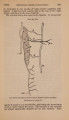
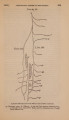
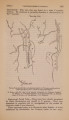
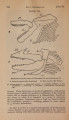
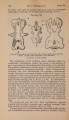
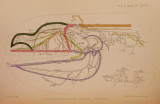
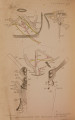
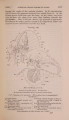
Show 1 0 1 0 MR. L. R. CRAWSHAY ON THE ARTERIAL [Dec. 11, however, that in Bufo boreas a large dark reddish compact gland attached ventrally to the distal end of the middle and posterior arches, and similar in appearance to the thyroid, had no connection whatever with this artery, but was supplied 011 both sides of the body by a branch of the subclavian*. From the point where the r. lingucdis passes backwards to the tongue, a small branch of the carotis externa is continued forwards in the M. geniohyoid,eus to the edge of the lower jaw. In R. tigrina and both species of Bufo this vessel ended here, but in the rest of the species examined it formed an anastomosis wdtli the r. maxillaris inferior of the A. occipitalis. A. carotis interna.-I was unable to observe the A. pharyngea ascendens described and figured by Ecker, and afterwards in the translation of Haslam, as a branch of this artery in any of the specimens examined, but in all cases the first subdivision of the artery occurred just as it enters the inner posterior angle of the orbit and passes into the skull, giving off the Aa. ophthalmica and palatina with other unimportant small vessels almost simultaneously. There is no reference to such a branch of the carotid in Gaupp's edition, and unless its insertion can have been due to some error, its occurrence as a noteworthy vessel would seem to be abnormal. The connection of the A. palatina with the Harderian gland was always very marked, the main vessel turning inwards to the gland as it reached the anterior border of the orbit. This gland occupied a constant position against the eyeball in close contact with the M. ohliquus inferior. In R. hexadactyla it formed the centre of a complete anastomosis betwTeen the Act. palatina and ophthalmica, and the orbito-nasctlis and maxillaris superior of the occipito-vertebrcdis, the palatina uniting with the orbito-nascdis just before reaching the gland. The gland in this case especially was completely suffused with the colour of the injection, as is so noticeable in the spleen, or, less distinctly, in the thyroid (text-fig. 147, g.h., p. 1019). II. S y stem ic S y s tem . The A. Ictryngea was constant in occurrence and position, leaving the systemic arch opposite to the carotid gland. As the systemic arch passes up to the dorsal body-wall, the first trunk to be given off was in all cases the occipito-vertebrcdis, the subclavict very soon afterwards branching off from the aorta and crossing the base of the occipito-vertebralis dorsally in its outward course. The A. cesophagea seems in most cases to arise from the base of the occipito-vertebrcdis. Such was the case in R. clamata, R. hexa-clactyla, R. tigrina, B. mauritanicus, and B. boreas. In R. tempo- * No attempt is made here to discriminate between the several factors which may make up the sometimes very irregular glandular masses in this region, and the term thyroid is used for them collectively with some reticence (cp. H. Norris, Anat. Anz. vol. xxi. p. 221). |