| OCR Text |
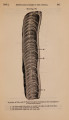
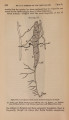
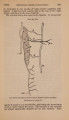
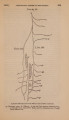
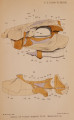
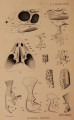
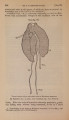
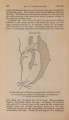
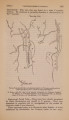
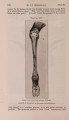
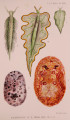
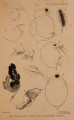
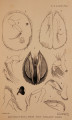
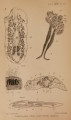
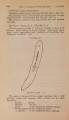
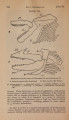
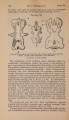
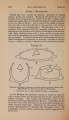
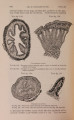
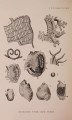
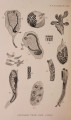
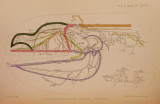
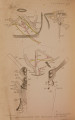
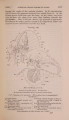
Show G72 Silt C. ELIOT ON NUDIBRANCHS [June 19, Just below the oral veil on either side are two flat folded lobes (4 mm. long by 3 broad) which appear to represent tentacles. A huge proboscis, unlike anything which I have ever seen in the Nudibranchiata, is everted under the oral veil and folded under the body of the animal (PI. XLVII. fig. 2 b). It is 98 mm. long, and 34 mm. broad at its base, but tapers towards the tip, where it is about 8 mm. broad. The radula, which was found at the point marked c on this proboscis, is torn into several longitudinal strips, and the rhachis and innermost teeth can no longer be distinguished. When perfect, the ribbon must have been very large, consisting of between 300 and 400 transverse rows, each containing at least 200 teeth on either side of the rhachis. All the teeth examined are as figured by Farran (I. c. plate iii. figs. 23, 24), tricuspid with long bases. From this strange buccal apparatus a strong muscular tube, about 30 mm. long, 12 mm. wide, and nearly straight, runs to the liver, enters it and re-emerges as the intestine. Within the liver is a small stomach which seems to receive only one hepatic duct. The walls of the stomach and intestine are quite distinct within the liver. The liver itself is about 57 mm. long and 38 broad, tapering posteriorly. It is elongate-ovate in shape and greyish in colour. Its relations to the hermaphrodite gland are not clear. The central nervous system is enclosed within a strong white capsule, but is itself rather dark grey. The general outline is as usual, suggesting the three pairs of ganglia, but no division into ganglia is traceable in its substance. It seems to be composed of a mass of large and small granules not set in groups. The genitalia are not well preserved, but owTing to their large size the principal features can still be ascertained. The ampulla of the hermaphrodite gland is much convoluted. It is about 3 mm. broad and, as coiled, 30 mm. long. At its end comes the bifurcation of the male and female branches. The first part of the male branch is enveloped in a large lobed organ, which is apparently the mucus-gland, and enters the female branch close to the bifurcation. When free from this gland, the male branch appears as a broadish tube (5 mm.) with rather thin walls. It dilates into an elliptical expansion (presumably a prostate) about 15 mm. long and 10 mm. broad, with thickish walls and empty inside. After this dilation it becomes a thin-walled free tube, 35 mm. long and 5 mm. broad, running to the penial pouch. The vas deferens within the pouch is straight and not convoluted. The lower part of the vas deferens bears an armature of numerous, minute, brownish spines of very various shapes and sizes-long, short, straight, wavy or hooked, but mostly with narrow bases. The glans penis is formed, as Bergh says, somewhat as in Phialodoris. There seem to be two elongate lateral folds of skin, and in the middle another fold surrounding a rather irregular opening. After the bifurcation the female branch is thin and constricted. It receives the ducts of the above-mentioned mucus-gland (?) and of the large hard albumen-gland. Then comes the |