| OCR Text |
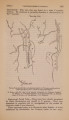
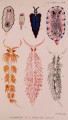
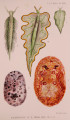
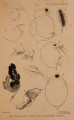
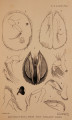
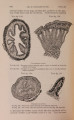
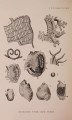
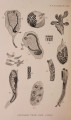
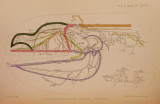
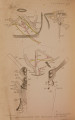
Show 1 9 0 6 . ] OF SOUTHERN INDIA AND CEYLON. 643 The coloration is not uncommon, and it is quite possible that the species has been described again with a fresh name, but I cannot identify it with any other form. Chromodoris tennentana (Kelaart). (Plate XLIII. fig. 1.) (Kelaart, 1. c. III. p. 268.) This appears to be another Chromodoris with an ample mantle-margin. In colour it offers analogies to Chr. obsoleta (Riippell & Leuck.), Chr. imperialis (Pse.), and Chr. aureopurpurata Colling-wood, but does not agree completely with any of them. C hromodoris diardii (Kelaart). (Plate XLIII. fig. 2.) (Kelaart, 1. c. III. p. 267. = Chr. semperi Bergh in Semper's Reisen, Heft xi. pp. 482- 484.) The resemblance in coloration seems to me sufficiently strong to justify the identification of these two forms. Chr. rundnata is nearly allied, but neither Kelaart's description nor his figure gives a hint of the conspicuous spherical glands beneath the mantle-edge. I regret to substitute Kelaart's name for that given by Bergh, but follow the precedent of the latter authority, who has changed his Chromodoris elizabethina into Chr. quadricolor (Riippell & Leuckart). See Bergh in Semper's Reisen, Theil vi. Lieferung ii. p. 68. Chromodoris gleniei (Kelaart). (Plate XLIV. fig. 1.) (Kelaart, 1. c. I. pp. 294-5.) This form appears to be clearly a Chromodoris in virtue of its general shape and simply pinnate branchiae. It is said to be found " in the Inner Harbour (Trincomalee), as also at Cottiar opposite Fort Frederick," and will probably be identified without difficulty on account of its striking coloration. Kelaart's picture has probably faded, for he describes the back as bearing " a deep golden-coloured patch, bordered and spotted with purplish red," whereas in the plate the patch is reddish brown with a margin of spots of the same colour but darker. The mantle appears to be ample; and the animal probably belongs to the same group as Chr. reticulata, Chr. sykesi, Chr. cavce, &c., and may even be identical with the last of them, in which case the name gleniei has priority. Chr. alderi (Collingwood, Trans. Linn. Soc. ser. 2, Zool. vol. ii. 1878, p. 132) also presents resemblances. C hromodoris inopinata Bergh. (Bergh, Siboga-Expeditie, Opistliobranchia, 1905, pp. 157-9.) This species is allied to Chr. sykesi Eliot (Proc. Zool. Soc. 1904, i. pp. 387-8). It has the same shape and a similar though not |