| OCR Text |
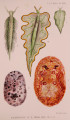
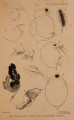
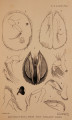
Show 652 SIR C. ELIOT ON NUDIBRANCHS [June 19, of the branchial opening are also variable. In one specimen it is nearly closed ; in another it is almost stellate. But in its natural condition it seems to be broad and circular. The foot is broad, grooved, and notched in front. The oral tentacles are long, digitate, and pointed. The most distinct external character is that the back is studded with small tubercles of varying size and of a lighter tint than the ground-colour. The peculiar effect which this produces in the appearance of the animal is well rendered in Alder and Hancock's plate. The tubercles are of somewhat irregular outline, and often have a long pointed tip. Though they are numerous, they are separated from one another by distinct intervals. Though the tissues of the buccal organs are decayed, the hard parts are still recognisable. The labial armature is formed of longish, bent, transversely striated rods. The teeth are yellowish, hamate, moderately stout, and of a somewhat wavy outline. They are very like Bergh's plates in the 1 Siboga ' Expedition (I. c. pi. xiv. fig. 4). The genitalia are decayed, but no armature was found. Bergh, in describing various specimens of his Discodoris con-cinniformis, has indicated its probable identity with this species. There is no divergence in the buccal parts; but it is curious that Bergh, while describing D. concinniformis as bearing light-coloured spots, does not state definitely that the tubercles are lighter than the dorsal surface, which is the cause of the peculiar coloration of D. concinna. D iscodoris fr ag il is (A. & H.). (A. & H. 1. c. pp. 118-119.) The remains of two specimens are preserved, but in so fragmentary a condition (the result probably of self-mutilation, not of dissection) that nothing can be profitably described except the dorsal surface. No buccal parts were found. The ribbon-like strips, of which the remains mostly consist, are soft and slimy, but rather stiffer on the upper surface. This is covered with round, blunt, white tubercles, contrasting with the ground-colour, which is brown of different shades. The general appearance, however, is not like Disc, concinna. Towards the mantle-edge the tubercles become harder, and the edge itself seems to be marked in places by a continuous calcareous deposit. The integuments are not visibly spiculous, though they contain numerous spicula. These are as described by Alder and Hancock : small rods of rather irregular outline, often bent in the middle and with blunt or broad extremities. S taurodoris r u st icata ? (A. & H.). (A. & H. 1. c. p. 120.) Four smallish specimens labelled " Madras from Sir W. Elliot" are probably Doris rusticata A. & H., though there is no name |