| OCR Text |
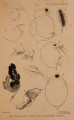
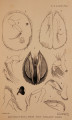
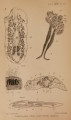
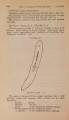
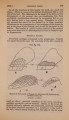
Show 1 9 0 6 ,] OF SOUTHERN INDIA AND CEYLON. 6 8 3 L in g u e l l a sa r a s in ic a Bergh. (Bergh, " Weitere Beitr. zur Xennt. der Pleuroph.," Verb, k.-k. zool.-bot. Gesells. Wien, 1890, pp. 10-12. Eliot, " Nudibr. from the Indo-Pacific," J. of Conch, ii. 8, 1905, pp. 240-1.) A single specimen, which looks well-preserved but is very soft and crumbly. It is broad and flat, but rolled up. If stretched out, it would be about 60 mm. long and 40 wide. The colour is yellowish grey of various shades, with a white border round the mantle. The back is covered with tubercles of various sizes. The smaller are mostly pointed. The larger are flat roundish plates, as much as 2*5 mm. broad, and showing signs of a central peak which has perhaps been flattened by artificial pressure. At first sight the conformation of the anterior part seems to be as in PleurophylUdia, the mantle-margin being continuous behind the rhinophores. But the white border is interrupted, and a careful examination proves that the apparently continuous fold is due to contraction, and that the dorsal surface is prolonged uninterruptedly between and before the rhinophores. The surface in front of the rhinophores is studded with conical papillae and flat tubercles like those of the back but rather smaller. The gills lie between the body and the mantle-edge, not in a cleft. They are only 30-40 in number, thin and of varying size, the largest being 7 mm. The side-lamellae are much larger and thicker than the gills, but are not numerous (20-30). They are often interrupted and broken, so that it is hard to count them. The tail is short, and there is a deep furrow in the posterior part of the foot. The yellow jaws are large, each being about 11 mm. long and 5 mm. broad. The middle part is very convex. The edge bears minute irregular lumps, but is not denticulate. On the inside of the masticatory process is a triangular membranous flap about 2 mm. long. The radula consists of 55 rows containing 120-130 teeth on each side of the rhachis. The rhachidian tooth is not very wide but arched, with a deep sinus behind. The central cusp is moderately prominent, and bears 2-3 denticles on its slope ; below them are about 8 ridges terminating in denticles on either side of the tooth. The first lateral is hardly hamate, but squarish with a few (generally 4) denticles. The remaining teeth are hamate. The second and third bear 8-12 denticles. Then the number of denticles decreases, and after about five teeth the appearance is bifid, though accessory denticles beneath the bifurcation occur throughout the row. In general, the denticulation is irregular. Smooth teeth occur here and there throughout the outer half of the row, and the last ten are usually, though not invariably, smooth. I think this form may be referred to L. sarasinica, recorded from Trincomalee and the Persian Gulf. The jaws, however present differences, and are not denticulate as in the specimens previously examined. But the denticulations may wear off in the larger and older individuals. |