| OCR Text |
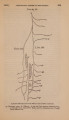
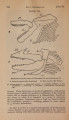
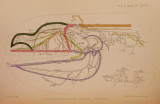
Show 1906.] VASCULAR SYSTEM OF THE IIELODERM. 609 and thus forms a part of the hepatic portal system. On the right side of the liver, a little process of liver-substance juts out to meet the vein. This does not occur in the case of the left-hand vein. The arrangement of oviducal membrane and the vein which it bears appears to me to be exactly the same as a corresponding series of structures which I described some time ago in the Charmeleon*. Epigastric Feins.-These veins in Heloderma (text-fig. 99, p. 602) form a median unpaired system unlike the corresponding veins of Varanus. The principal vein of the system enters the liver very anteriorly quite close to the end of that organ. The epigastric generally, it is to be observed, is connected with the liver well in front of the entrance of the umbilical vein. The main stem of the epigastric was broken off, and a corresponding break on the largest branch of the abdominal vein may perhaps indicate the junction of the two. The main stem, whose actual course I am thus unable to map, gives off a backwardly running branch which extends beyond the liver. This latter stem is also connected directly with the liver itself by two branches which it gives off just before ending in the main stem of the epigastric. These form an anastomosis with each other, and there are altogether formed three exits into the liver, in addition, of course, to the main epigastric stem. Arterial System.-Dr. Shufeldt, in his memoir already referred to f, has made a few comments upon the arteries arising from the aorta behind the heart. He has not, however, dealt in any way with the arteries at their point of origin from the heart. The general arrangement of the exits of the arteries does not seem to me to differ from what is found in the Lacertilia generally. The heart also is bound to the pericardium by the tag which is so general in the group. On the right side, the systemic trunk and the carotid run side by side for a long distance after their emergence from the common trunk by which they originate from the ventricle. The systemic trunk then doubles upon itself to pass back towards its point of junction with the aorta of the opposite side of the body, the carotid continuing its forward course. There is not the least trace, that I could discover, of the ductus Botalli joining the systemic and carotid arches, which is so prevalent among the Lacertilia. The contact between the two trunks concerned is so close and exists for so long a space, that there is, so to speak, every opportunity for the connection to have been preserved. Yet it is absent. In this feature Heloderma obviously agrees with Varanus and Amphisbcena, in which genera there is no such ductus Botalli to be found. The left aortic arch gives off no branches. The right aorta o-ives off several pairs of intercostals as well as the subclavians, which as in many Lizards, arise the one behind the other. As is the rule elsewhere, the left subclavian arises behind the right. Yery shortly after the junction of the two aortse arises a slender * " Contributions to the Anatomy of the Lacertilia," P. Z. S. 1904, vol. ii. p. 9. f P. Z. S. 1890. |