| OCR Text |
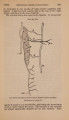
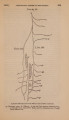
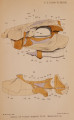
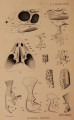
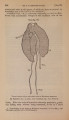
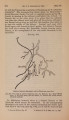
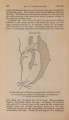
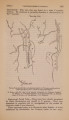
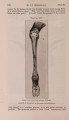
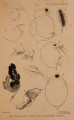
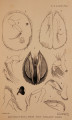
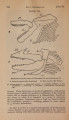
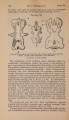
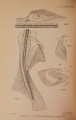
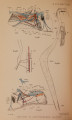
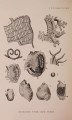
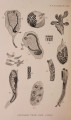
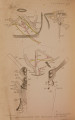
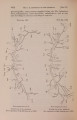
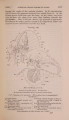
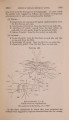
Show The Interhyal, connecting the hyomanclibular with the rest of the hyoid arch, articulates with it almost at the same point as the symplectic does. It is a small bone tipped at both ends with cartilage. The rest of the hyoid arch is much compressed laterally so as to form the " hyoidean cornu " of Prof. Parker, and is made up of four bones, the epi- cerato- and two hypo-hyals. Of these the Epihyal, a flat semicircular bone, articulates with the interhyal, forming the upper rounded end of the cornu. It lies posteriorly to the ceratohyal as in R. glesne. The Cercitoliyal, like that of R. glesne, is the largest of these bones, but relatively much longer and narrower than in that species. It intervenes between the epihyal and the two hypohyals, forming the posterior lower margin and but a small part of the dorsal margin of the arch. The Hypohyals, of which there are two, take a greater share in the formation of the " hyoidean cornu " than in R. glesne, being together almost equal to the ceratohyal. The larger and upper one forms most of the anterior margin of the cornu, while the smaller and lower one (h.hy.') forms the rest of the anterior and the whole of the mesial margin where the hyoidean cornu is attached to the glossohyal. This lower one seems forked on the inner side, but this is due to the lower corner of the ceratohyal overlapping and concealing part of it. In fig. 2 the concealed part of the margin is indicated by a dotted line. C. The Opercular Bones. Of these there are four, and all are visible through the skin of uninjured fish. The Opercular itself is a subcircular bone having a concave facet for articulation with the hyomandibular. It has three borders, all curved, one of which faces anteriorly, one dorsally, and the other postero-ventrally. Below the opercular is the Subopercular, a narrow plate of very delicate bone. In neither of these bones is there a marked difference from the corresponding bones in R. glesne (PI. X XXIX. figs. 6 & 7). The Preopercular is one of the largest bones in the skull, extending from the anterior border of the opercular to the anterior end of the quadrate, making a total length of one and three-quarter inches. Thus it forms a considerable part of the suborbital region of the face. Instead of the greatest length being in a vertical direction as is usual, it is here in a horizontal direction. The difference between the preopercular in the two species is very marked. In the present species the greater part of the bone is horizontal and suborbital, whereas in R. glesne the greater part is vertical and postorbital. Again, in the latter species the anterior and posterior margins are gently and regularly curved, but in R. parkeri the lower margin is straight for some distance and then curves suddenly upwards (PI. XXXVIII. fig. 1). 550 . PROF. w. B. BENHAM AND MR. W. J. DUNBAR ON [May 15, |