| OCR Text |
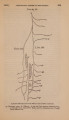
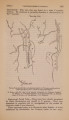
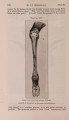
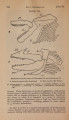
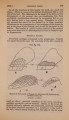
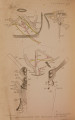
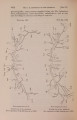
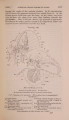
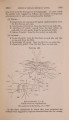
Show 1906.] VASCULAR SYSTEM OF THE CROCODILIA. 625 in question before they finally join to enter the liver. An inspection of the figure will do away with the necessity of a detailed description. In addition to these three stouter vessels a more slender trunk arises (behind them) and is connected above with the veins running directly from the stomach to the liver. This vessel (in both specimens, I believe, but certainly in one) is also derived from the lateral parietes, and thus exactly corresponds to a similar vessel in Crocodilus cataphractus, which is also in the same way the last of the series. In Caiman sclerops there are again differences of detail. The right and left sides are shown in the accompanying figures (text-fig. 106, p. 623). In both cases there is a branch from the lateral parietes, which, as in other Crocodilia, is the last of the series of the parieto-hepatic veins. On the right side only two trunks arise from the azygos, but the posterior immediately divides to shortly reunite with both of the primary branches. On the left side there are only two vessels arising from the corresponding azygos. These are fused immediately after their origin, but divide again at once. Further details will be obvious from an inspection of the illustrations. In comparing the course of these vessels in the several Crocodilia which I have had the opportunity of examining, it is possible to arrive at certain differences and agreements between the four species dealt with. In the Crocodiles (C. acutus * and C. cataphractus) the number of trunks forming the dorsal parieto-hepatic affluent of the portal system is greater by one or two than in either Osteolcemus or Caiman. On the other hand, in the two last-named genera the interconnections between the several trunks before they unite to open into the liver are to be remarked, and are not seen in the two species of Crocodilus. Furthermore-but as this depends upon negative evidence, less stress is laid upon it-the vein in question in Osteolcemus and Caiman is connected before its entrance into the liver with the stomach plexus of veins. It is interesting to observe that in this system of veins as well as in others Osteolcemus and Caiman show likenesses to each other and corresponding differences from Crocodilus. In addition to the constantly present laterally arising trunk which in all the Crocodilia examined joins the dorsal parieto-hepatic vein, there are other vessels also lateral in origin which have a separate entry into the liver. In Osteolcemus tetraspis three slender veins arise from the parietes laterally more ventrally than the lateral affluent of the dorsal parieto-hepatic already described; each enters the liver separately. On the left side I could find only one corresponding vein. In Crocodilus catciphractus each lobe of the liver has also a corresponding vein originating from the lateral parietes. It enters the liver ‘between the anterior abdominal and the dorsal parieto-hepatic veins. I have not observed this vein in other Crocodiles. * P. Z. S. 1905, vol. ii. p. 466. 42* |