| OCR Text |
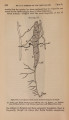
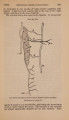
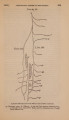
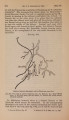
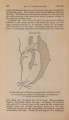
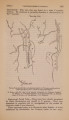
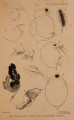
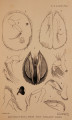
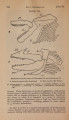
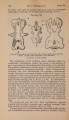
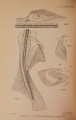
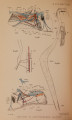
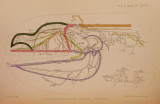
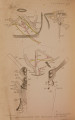
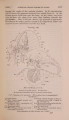
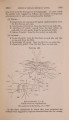
Show 1906.] ANATOMY OF CENTROPHORUS CALCEUS. 8 7 9 immediately under the supra-orbital ridge. Whether there is any interchange of nerve-fibres I cannot say. The nerves, concerning the identity of the branches of which, as usual, there is doubt, are the trigeminal and facial, and this question of identity is complicated by the fact that the disposition of the nerves is slightly different 011 the two sides of the head *. The roots of the fifth and seventh nerves, in the first place, are different 011 the two sides of the head. O11 the left side (PI. LX1. fig. 16) t the nerves which I (very possibly incorrectly) term the ophthalmicus superficialis (0 . S. VII.), ophthalmicus profundus (0. P. VII.), and palatine (P. V I I .) of the seventh originate from a distinct root which is the most anterior of the three giving rise to all the branches of the fifth and seventh nerves; on the light side (fig. 1 7 )t this anterior root, distinct at its origin, is later fused with the other two roots. On the left side again, the ophthalmicus superficialis clearly arises from this anterior root, but 011 the right it is bound up, for an inch or so, with the large ophthalmic branch of the fifth (O.V.), and hence appears to arise from it. The ophthalmic of the fifth- a very conspicuous nerve- on both sides entirely or mainly arises from the second root of the primary three. This large ophthalmic of the fifth runs along the upper border of the orbit, and sooner or later is joined towards the anterior limit of the orbit by the smaller ophthalmicus superficialis of the seventh, and these (with the ophthalmicus profundus which joins them about half-an-inch in front of the cerebral hemisphere, after piercing the anterior cartilaginous wall of the orbit) ramify over the skin 011 the dorsal surface of the snout, supplying the mucous canals in the usual manner. T1 le huge nerve which, like the fifth ophthalmic, appears to arise mainly from the second root of the fifth and seventh nerves, and which runs outwards in the floor of the orbit, I have termed the superior maxillary of the fifth (palato-nasal is perhaps better). Anteriorly it divides into several branches supplying the ventral surface of the snout, and near its origin gives off a smaller nerve which extends downwards at the back of the orbit and forks into anterior and posterior branches which I have respectively named the inferior maxillary (I. M. Y.) and mandibular (MX. V.) of the fifth. This nerve is joined, on both sides of the head, by a branch from the palatine (?); in addition to this, it gives oft' anteriorly on the right side a small nerve (Y.L.) which runs almost parallel to i t : on the left, the same small nerve originates independently from the large superior maxillary. The large size * As Prof. Hickson kindly pointed out to me, Collinge lias previously described, in 1895, other instances of the asymmetrical distribution of the fifth and seventh cranial nerves in several Teleosts (" O11 the IJnsymmetrical Distribution of the Cranial Nerves of Fishes." Jour. Anat. Physiol, vol. xxiw). f It is almost needless to say that in the dissections represented by both figs. 10 & 17, large masses of cartilage have been removed both in front of and behind the orbital cavity in order to expose the nerves better, and the same remark applies to a large muscle which laj' in the floor of the orbit just anterior to the large vertical process arising from the upper jaw. The auditory organs have of com-se also been removed. |