| OCR Text |
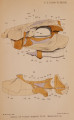
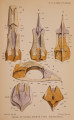
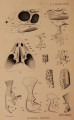
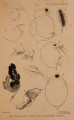
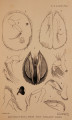
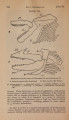
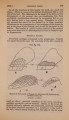
Show 594 DR. R. BROOM ON A SOUTH AFRICAN [May 29, imperfect or insufficiently displayed, or the determination too uncertain to warrant description. A portion of the nasal preserved shows that the bone was of considerable size, as in Pcilceohatteria. I n specimen A a number of bones of the palate are preserved. Though these are imperfect, yet as the pterygoids are fairly com plete it is possible to make an approximate restoration of the palate. The pterygoids are of the triradiate type found in most early reptiles, such as Dmietrodon, Proterosuchus, Procolophon, &c., and, as in these genera, are dentigerous. The anterior process is long and narrow, and along apparently its whole length is a single row of small teeth, which must lie almost parallel with the corresponding row on the pterygoid of the opposite side. The posterior half of the anterior process is about twice as broad as the anterior, and on it is a second dental ridge with at lea,st two rows of fairly well-developed teeth passing forwards and slightly outwards from near the back end of the inner dental ridge. The anterior ridge articulates by much of its outer side with the palatine. From the posterior part of the toothed portion of the t one the median process passes outwards and slightly forwards. It appears to be devoid of teeth. From about the same point the posterior process is sent backwards and outwards, doubtless to meet the quadrate. This process is broad, fan-shaped, and concave, and recalls rather forcibly the posterior process of the pterygoid in Procolophon and Dimetrodon. The palatine is very imperfect, but it appears to be moderately flat and devoid of teeth. A considerable portion of each mandible is preserved, but not in a very satisfactory condition. The dentary carries four rows of small obtusely pointed teeth almost exactly similar to those of the maxilla. Unfortunately, only the back part of one dentary is preserved, and the cast of the back part of the other. The preserved portion is 4 mm. wide. The post-dentary portion of the jaw has a swollen appearance, recalling that of Procolophon, but it is much larger in Howesia. The bone which forms the greater part of the outer side I believe to be the surangular. In situation it quite agrees with the supposed surangular in Proco-lophon, but in the latter genus it is much smaller. In Proterosuchus the surangular is also of very large size. There appears to be a small but distinct coronoid bone. The angular seems to form nearly the whole of the lower border of the posterior two-thirds of the jaw. In the middle of the jaw there is a very large cavity as in Procolophon. Lying on the pterygoids were two long, rounded, slightly curved rods of bone at least 22 mm. in length. These are probably hyoid bones. Vertebrae. 1 hough portions of many cervical and caudal vertebras are preserved as well as parts of a few others, they are for the most part not |