| OCR Text |
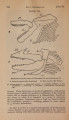
Show 1006 SIR C. ELIOT ON THE NUDIBRANCHS [Dec. 11, rhachis, of which the last 5 are degraded but not denticulate, though perhaps jagged here and there. The teeth are markedly smaller near the rhachis and increase outwards, not becoming smaller again until quite the end of the row. In the front part, as preserved, the rows bend downwards and are crowded in the middle. Behind, the two sides are pulled apart, so that there seems to be a broad rhachis, on which are teeth that may possibly represent rudimentary median plates, though they may also be merely broken teeth out of place. This dentition supports the idea that U. rusticata belongs to the same group as Staurodoris verrucosa. The genitalia are unknown. D oris v il losa A. & IT. 1. c. p. 119. = Thordisa villosa (A. & H.). = Th. maculigera Bergh. One radula, consisting of one large piece and two fragments. The formula appears to be about 60 x 70.0.70. The teeth increase in size from the rhachis outwards. The innermost are low, with long bases. Those near the end of the row are large, strong, and distinctly hooked. The 3 or 4 outermost are different: thin, not much hooked, and with the tip divided into hair-like denticles. In some rows this formation is obscured by the medium in which the teeth are mounted, but it is quite clear in many cases. This radula seems to place beyond doubt the identity of Th. villosa and Th. maculigera, since the type-specimen of the former possesses marginal teeth bearing hair-like denticles. D oris spongiosa Kelaart. Should probably be called Trippa spongiosa (Kelaart) = T. areolata (A. &, H.) and Trippa (Phlegmodoris) mepliitica Bgh. One radula, broken and torn into two parts for most of its length. There are only 15-16 rows, each containing about 35 teeth, on either side of the rhachis. The 4-5 innermost are shorter and smaller than the rest, which are hamate, white, and erect. The last 1 -2 decrease in size, but appear to be still hamate and not denticulate. T. areolata (23 x 40.0.40) and T. meph itica (30 x 55.0.55) also have short radulae of a similar character, and the identity of the three species is very probable. D oris tristis A. & IT. 1. c. pp. 121-2. ? = Trippa tristis A. & Ii. The single radula is accompanied by the note " no collar apparently," and is divided down the rhachis into two detached halves. There are only 17 rows, each containing about 28 or 30 teeth, on either side of the rhachis, but it is difficult to state the number of teeth exactly, as the innermost are scattered over the space between |