| OCR Text |
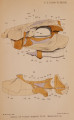
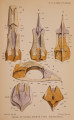
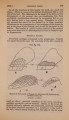
Show 7 6 6 MR. OLDFIELD THOMAS ON [Nov 13, colour above pale liair-brown with a tinge of buffy, the lining from the dark tips of the longer hairs well-marked. Individually the ordinary hairs are dark slaty for three-fourths their length, their ends dull clay-colour. Under surface similar to upper, but rather paler, without lines of demarcation. Ears of medium length, their proectote black, their metentote grizzled blackish, their edges with a well-defined white rim. Upper surface of hands and feet dull greyish white. Tail rather short, wellhaired, the scales quite hidden; dark brown above, dull white below. Skull with many of the essential characters of that of M. lineo-latus, but smaller, the supraorbital margins more sharply angular, the front edge of the zygomatic plate less deeply concave, the palatal foramen much shorter, and the bullae smaller. The palatal foramina are narrowly pointed behind, and barely project between the front of the roots of m1. Mesopterygoid fossa broadly open, the palatal edge well in front of the anterior end of the para pterygoid fossa?. Molars constructed as in M. lineolatus, but narrower, though broader than in M. higginsi. Dimensions of the type, measured in the flesh Head and body 145 mm.; tail 110 ; hind foot 27 ; ear 20. Skull-greatest length 32 mm.; basilar length 26 ; greatest breadth 17*2 ; nasals 11*5 X 3-7; interorbital breadth 4'2 ; breadth of brain-case 14'4; palatilar length 14*6; palatal foramina 7x2; length of upper molar series 5'7 ; breadth of m‘ 2. Hab. Sl type as above. This Rat, which I have much pleasure in naming after its captor, belongs to the peculiar Australian group of which Mus lineolatus Gould, of New South Wales, and M. higginsi Trouessart (M. leucopus Higg. & Pett.), of Tasmania, have hitherto been the only known members. Within the group the Tasmanian species is at once distinguished from both the Australian forms by its very long tail and narrow molars, while the new western species may be separated from its eastern ally by its rather smaller size, paler colour, and by the cranial characters above noted, of which the most tangible are the narrowness of the molars and the shorter palatal foramina. 16. MUS ALBOCINEREUS Gould. 22 from Stockpool and Dwaladine. " Frequenting sand plains ; plentiful east of Beverley. Their burrows differ from those of Aotomys goulcli by having sand thrown iq> around them; they also'often seem to fill up the entiance of these burrows when inside-when they are very difficult to detect."-G. C. S. 17. Mus musculus L. 5 from various localities. " The common House-Mouse, besides swarming in all the |