| OCR Text |
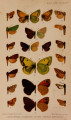
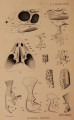
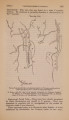
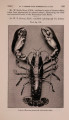
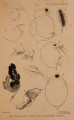
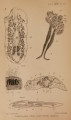
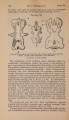
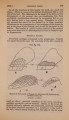
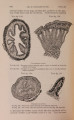
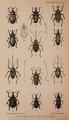
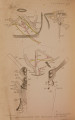
Show containing a few small black spots. Legs black, with dense white scaling, posterior pairs of femora with a black spot towards apex, tibiie with apex and a central patch black; all femora armed with a large triangular tooth. M ashonaland : Salisbury and Umcheki R. (G. A. K. M.). M atabeleland : Matopos (P. A. Sheppard), Plumtree (Father O'Neil). T yp e in the British Museum. P iiacemastix poultoni, sp. nov. (Plate LXYII. fig. 2.) Long. 6A-7J, lat. 2|-.‘>| mm. Colour black, prothorax with a ring of sparse white or yellowish scaling round the entire apical margin and a small patch of similar scales at each basal angle; elytra dark red, with the base and apex broadly black and with twro broad transverse bands of white scales, one at the extreme base and the other dividing the red from the apical black; under parts black, with more 01* less sparse white scaling, forming denser patches on the meso- and metasternum. Head subconical, closely punctured ; eyes large, convex and meeting dorsally in both sexes. Postrum as long as prothorax, curved and strongly deflected, its sides subparallel; apical portion flattened, bare and coarsely punctured throughout; basal portion somewhat compressed superiorly, with three dorsal carinse, the two outer ones uniting near base with the central one, which is more elevated and ascends the forehead, the sides rugosely punctured and with sparse white scaling. Antennce dark ferruginous, writh white setre ; the club fuscous, shorter, about equal to the last three joints of the funicle. Prothorax as broad as long, sides scarcely rounded, broadest at base and gradually narrowed to near apex, where there is a sharp constriction, base deeply Insinuate, apical margin shallowly sinuate dorsally; upper surface moderately convex, with deep subreticulate punctuation throughout and with only a trace of a central carina. Elytra jointly sinuate at base, broadest at shoulders, which are roundly prominent, and thence gradually narrowed to apex ; upper surface almost plane, depressed near the scutellum, which is black, bare, and rugosely punctured; the strife broad and deep, containing rows of large shallow punctures, the intervals not broader than the strife, plane and coarsely punctured. Ijegs black, evenly covered with rather sparse depressed white setfe; all the femora with a large sharp tooth. M asijonaland : Salisbury (G. A. K. J/.). T ypes, c? in the British Museum, £ in the Oxford Museum. • ^ j if •VV ^ 111 uc^ pleasure that I dedicate this species to my an* triend Prof. E. B. Poulton, F.R.S., the Hope Professor of . 00 Oxford, to whom I am deeply indebted for much invaluable aid in my entomological work. /. hat ul 10ides Fa hr. is the only other described species of this ^enus, an< las a strikingly different coloration from any of the toregomg insects. 942 MR. G. A. K. MARSHALL ON [Dec. 11, |