| OCR Text |
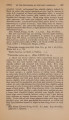
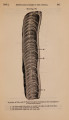
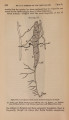
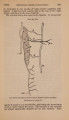
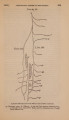
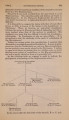
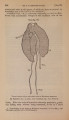
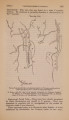
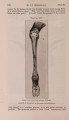
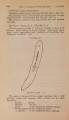
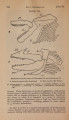
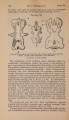
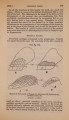
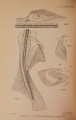
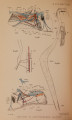
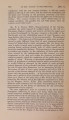
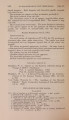
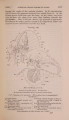
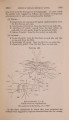
Show 1906.] RESPIRATORY SYSTEMS IN THE OPHIDIA. 525 itself, but certain of the alveoli (about two I think) of the latter are deeper than the rest and communicate with the pulmonary appendage. In a transverse section of the latter it is seen to be for the most part solid, with a cavity at either side. It seems to be a prolongation of the outer edge of the lung proper, which is thicker in its wall than the rest of the lung. There is no special communication of the headward extension of the lung with the trachea. The lung ceases to be vascular some way down the liver, and ends altogether a few inches before the termination posteriorly of the liver. When the trachea of Erythrolampms (text-fig. 93, p. 526) is cut open, it is seen that, as in many (probably in all) Snakes, the tube is not completely encircled with the cartilaginous hoops. There is a median dorsal area which is occupied by soft tissue. This area of soft tissue is continuous with the lung-tissue, and, more than that, it is not merely a fibrous membrane but is divided into hexagonal cells. It presents, in fact, the honeycombed appearance of the lung though less marked. This is obviously a tracheal lung, recorded in this Serpent here for the first time, so far as I am aware. The tracheal lung of Erythrolampms is, however, of small dimensions. The cells are ranged not more than two or three deep. The lung therefore does not project dorsally from the trachea as in the better-developed forms of tracheal lung. It is not, in fact, wider than in many forms where there is no development of pulmonary tissue in this region, but merely a fibrous connecting-band between the tracheal semirings. The tracheal lung, however, inextensive as it is, seems to function as a lung, for it is vascular and of the same red colour as the functional lung below. It has, moreover, a special branch of the pulmonary artery supplying it. The pulmonary artery of this Snake is single (text-fig. 93). It reaches the lung at the apex of the anterior lobe, and passes obliquely back, lying ultimately to the outside of the lung outside of the vena cava inferior, which covers in the natural position of the viscera the pulmonary vein. The artery before it quite reaches the lung gives off a branch which at once divides into two. The lower of these branches supplies the anterior lobe of the lung. The upper branch turns back, and runs up the trachea along the pulmonary surface of that tube. It corresponds therefore to the anterior branch of the pulmonary artery in Bitis *, and to the tracheal branch of the pulmonary artery in certain Lizards +. The pulmonary artery can be traced nearly to the end of the lung; it is to be seen in the posterior anangious region of that viscus. At regular intervals it gives off branches running across the lung. In the anangious region these branches are slender; it is an interesting fact that they end by anastomosing with the intercostals above. The nutritive blood of the lung is therefore not separated from the respiratory blood. * Beddard, " Contributions to the Anatomy of the Ophidia," P. Z. S. 1906, vol. i. p. 36. t Id. ibid. p. 44. |