| OCR Text |
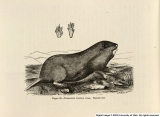
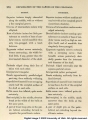
Show CHAPTER XIII. ABSTRACT OF RESULTS OF A. STUDY OF THE GENERA GEOMYS AND THOMOMYS* ' BY DK. ELLIOTT COUES, U. S. A. These two genera are closely allied; the principal difference being in the character of the sulcation of the superior incisors. In Geomys, the upper front teeth have a deep groove along the front face, at or near the middle, with or without a fine groove along the inner margin. In Thomomys^ the latter groove exists, but there is no other. The fore feet of Geomys are more decidedly fossorial than those of Thomomys, owing to greater development of the claws. In Geomys, the external ears are a mere rim surrounding the auditory orifice; in Thomomys, there is a decided, though small, auricle. The two genera constitute a perfectly natural group, of the grade of a family, which may be called GeomyidcB, equivalent to the subfamily Geomyince of Baird, or the Sciuro-spalacoides of Brandt. Their closest affinities are with the Saccomyida (Dipodomys, Perognathus, &c.), under which they have been placed as subfamilies by Waterhouse and Baird. These authors are certainly right in differing from those who, like Brandt and others, widely dissociate the two groups ; for, as Baird has insisted, they are very closely allied in all essential respects, notwithstanding their remarkable dissimilarity in contour and other superficial points. Still, I do not go to the length of the authors named in associating Geomys and Thomomys with Dipodomys, Perognathus, &c., in one; preferring to follow Gill in considering them as a distinct, though the * Based on the material contained in the National Museum, Smithsonian Institution, Washington, D. 0. 28 OOJL , |