| OCR Text |
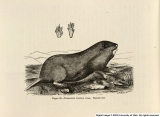
Show COUES ON GEOMYS AND THOMOMYS - T. TALPOIDES. 255 sharp spicule, clubbed at base, tapering and slightly curved, nearly three-quarters of an inch long. In a female, I have distinctly made out twelve rnammse, of which two pairs are inside the thigh, two pairs on the chest, and two pairs axillary. Few, however, if any, of the foregoing points are diagnostic of the species ; nor will the ensemble serve to distinguish it infallibly from its congeners, excepting T. clusius. As to form, the single character I notice is the greater average development of the fore claws, bringing the length of the hands up to about that of the feet. Some points of color about to be noticed are the most reliable distinctions. The animal is as nearly as possible like the house-rat (Mus decumanus). The whole upper parts are of a uniform grayish-brown, generally quite pure, though occasionally warming into a more reddish-brown. But, in the most reddish specimens, the tint is uniform, without the peculiar mottling or lining of a dark-brown with a reddish-brown which constitutes the richer color of the Pacific-coast bulbivorus. The only departure from the uniformity of the upper parts is a small blackish patch, usually very evident, in which the ears are set. On the sides of the body, the color gives way gradually to the lighter tint of the under parts: here we find the plumbeous of the roots of the hairs as a background to a hoary-grayish, resulting from the tips of the hairs. This hoary is usually quite pure, but it sometimes takes on an appreciably muddy-brown tinge, still never equaling, as far as known, the richer fulvous-brown which tones the under parts in the coast form. The tail and feet are white in every specimen I have seen; and, besides this, there are usually patches about the mouth, cheeks, throat, and breast, where the fur is pure white to the roots. But these white markings are wholly indeterminate in extent, as well as inconstant in appearing at all; in many cases, the parts are concolor with the rest of the under surface. Perhaps the strongest color-mark of the species is the absence from any part of the head of sooty-blackish or even dusky areas, there being no noticeable contra 4s of color between the mouth-parts and pouches; whereas, in T. bulbivorus, and, still more so, in umbrinus, these parts are dusky, or even coal-black, contrasting sharply with the pure-white linings of the pouches. The whiskers are mostly colorless; the claws are colorless, though usually stained with extravasated blood. Northern Dakotan and Minnesotan specimens may be taken to represent |