| OCR Text |
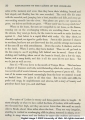
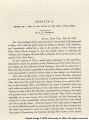
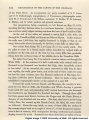
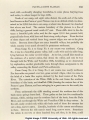
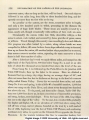
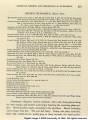
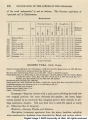
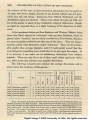
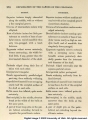
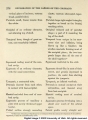
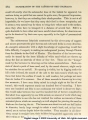
Show 276 EXPLORATION OF THE CANONS OF THE COLORADO. ICY GEOMYS. Superior incisors deeply channeled along the middle, with or without a fine marginal groove. Crowns of intermediate molars truly elliptical. Root of inferior incisor but little protuberant on outside of base of con-dylarramus; end of mandible thus only two-pronged, with a knob between. Zygomata widest across anteriorly, thence contracting; the width behind little, if any, greater than the intermastoid diameter of the skull. Parietals ridged along their line of union with each other. Interparietal triangular. Nasals approximately parallel-edged part way, then suddenly widening. Superficies of mastoid bone occupying nearly half the occipital surface of the skull on each side. Bullae ossesB less inflated, quite acute anteriorly. Basi-occipital, in the middle, about as broad as the width of the bulla at the same point. A pair of broad deep pits on the palate behind, extending forward to' opposite the penultimate molars. THOMOMYS. Superior incisors without median sul-cus, but with a fine marginal groove (sometimes obsolete). Crowns of intermediate molars acute-edged exteriorly. Root of inferior incisors causing a protuberance on outside of base of con-dylar ramus nearly as high as con-dyle itself; end of mandible thus singularly three-pronged. Zygomata regularly convex outward, with a sweeping curve; their breadth across posteriorly decidedly greater than the intermastoid diameter of the skull. Parietals ridged externally near the squamo-parietal suture. Interparietal rather pentagonal. Nasals widening uniformly from behind forward. Superficies of mastoid bone restricted to less than a fourth of the occipital surface on each side. Bullae osseae more inflated, quite obtuse anteriorly. ^ . Basi-occipital, in the middle, much narrower than the bulla at the same point. A pair of slight pits on the palate behind, not extending beyond the ultimate molars. |