| OCR Text |
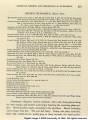
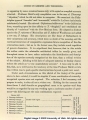
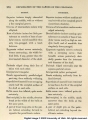
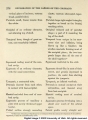
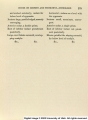
Show COUES ON GEOMYS AND THOMOMYS-OSTEOLOGY. 275 of distinct character in the two genera, furnishing the most ready means of diagnosis, not only of the genera, but of the species of Geomys, as already fully given in the body of this paper. The molars are perennial rootless prisms, as in Arvicolince and many other hard gnawers, but are small and of a very simple structure-at least in comparison with the complicate character which obtains in many rodents. The whole molar series is scarcely one-seventh of the length of the skull. They are implanted very obliquely to suit the peculiar conformation of the parts. The axis of the anterior upper molar slopes backward at an angle of about 45°, and the rest succeed with regularly-diminishing obliquity. The relation is reversed in the lower jaw, where the back molar slopes forward, the rest becoming successively more nearly perpendicular. There is the same number of teeth in both jaws, and they are quite similar in construction. The anterior molar in each jaw is a double prism; the others are single and simple, elliptical in cross-section, the first being a pair of ellipses laid together like a short broad figure-of-eight, and the last approaching a cylindrical figure. The relation of the molars to each other is somewhat singular. Their roots are all widely diverging, but their crowns come into close contact. This is effected by the curve in'their axis. Thus the front upper molar is curved with the convexity posterior; the rest are curved successively more and more, with the convexity anterior. Similar characters mark the under molars, though less strongly; and there is seen in these teeth, especially in the anterior ones, a lateral as well as fore-and-aft curve. This shape appears to be forced upon the teeth by the peculiar conformation of the alveoli. The molars are quite similar in the two genera, and scarcely aiford diagnostic characters, especially since there is some change in the details of the molar crowns with age and wear of the teeth. On the whole, however, it may be observed that in Geomys the molars-the immediate ones, at any rate->are more perfectly elliptical than they are in Thomomys, where a pinching-together of the exte rior portion of the ellipses tends to result in a pyriform contour. The principal cranial and dental characters of the two genera which compose the Geomyida may be shortly contrasted, as follows: |