| OCR Text |
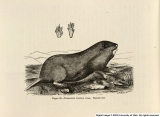
Show COUES ON GEOMYS AND THOMOMYS - G. BURSARIUS. 227 pilous character seen in that animal, but long and fluffy. The coat appears to be shed from before backward by a steadily progressing process, as witnessed by the definite lines of demarcation frequently observed. The plumbeous basal portions of the hairs, uniform to the very roots all over the body, are of such extent, and the colored terminal parts so short to correspond, that more or less of this color appears on all but the most daintily prepared specimens, and plumbeous is the prevailing tone of the under parts. The normal coloration is a dull reddish-brown, or impure chestnut, of varying intensity, frequently with a still duller muddy-brown superficial cast difficult to describe. This is the character of the upper parts, where a dusky dorsal area may or may not be appreciable. It gives way on the sides to the plumbeous of the under parts, which is overlaid with a hoary-brown or muddy-gray. The lips, chin, feet, and even legs, and the tail, are usually more or less white, the extent and purity of this white being wholly indeterminate; it is sometimes wanting; sometimes the tail is variegated with white and brown. There are also liable to be irregular white patches on the belly. The soles and palms, when not soiled by adventitious substances, are nearly colorless. The incisors, as usual, are orange-faced in the adult state. The claws are of an indefinite pale-brown color, often variegated with extravasated blood. The plumbago state, in which some specimens as large as any others are found, is entirely different, and does not appear to shade into the normal phase. Here the color is exactly that of a lead-pencil mark on white paper; but such is the gloss of the fur that violet, purplish, or even brassy reflections are shown with different lights. It is an intensification of the ordinary plumbeous basal portion of the hairs, and its extent over the whole fur. In this condition, white paws and tail, and other irregular patches of albinism, also occur. The plumbeous is seen in its purity only above; below, the fur is pointed with muddy-brown or gray. HISTORY.-Although its written history does not date so far back as the early notices of the 4iTucan" (G, mezicanus), this species was the first to be introduced to notice under a scientific name, and with a (supposed) scientific description. Dr. George Shaw was the physician who attended at the birth of the species, which he called Mus bursarius, giving a recognizable descrip- |