| OCR Text |
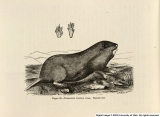
Show COUES ON GEOMYS AND THOMOMYS - T. UMBRINUS. 261 Little further discussion of the synonymy of this form is required than is implied in what has already been said. Professor Baird appears to have first satisfactorily identified the Diplostoma bulbivorum of Richardson with the animal subsequently described as Oryctomys bottce by Eydoux and Gervais. Preceding authors' use of the name had been altogether compilation. Schinz's name is a synonym upon its face, being a mere renaming of the same animal. The T. laticeps was based upon the individual peculiarities of a single specimen, the characters of which are more or less obscured by drying after immersion in alcohol. THOMOMYS TALPOIDES UMBRINUS, (Rich.) Coues. aeomys umbrinus, KICH., F. B. A. i, 1829, 202; Rep. Brit. Assoc. for 1836, v, 1837, 157. "Cadadaguios, Southwestern Louisiana"-more likely Texas.*-WATEKH., Charlesw. Mag. N. H. iii, 1839, 596, f. 71 (skull).-DEKAY, N. Y. Fn. 1842, 92. (Compiled from Richardson.)-SCHINZ, Syu. Mamm. ii, 1845, 137. (Compiled from Richardson.)-LEG., Proc. Acad. Nat. Sci. Phila. 1852,162. (Compiled from Richardson.) Ascomys umbrinus, WAGN., Suppl. Schreb. iii, 1843, 389. (Compiled.) Pseudostoma umbrinus, AUD. & BACH., iii, 1854, 307. (Compiled from Richardson.) Geomys (Thomomys) umbrinus, GIEB., Sang. 1855, 530. (Compiled from Richardson.) Thomomys umbrinus, BAIRD, M. N. A. 1857, 399 (redescribed from numerous New Mexican specimens).- BAIRD, U. S. Mex. B. Survey, ii, pt. ii, 1859, Mamm. p. -.-GERR., Cat. Bones Br. Mus. 1862,228. Creomys fulvus, WOODH., Proc. Acad. Nat. Sci. Phila. 1852, 201 (San Francisco Mountains, Arizona); Rep. Expl. Zuni and Colorado R. 1853, 51, pi. 5 (the same). Pseudostoma (Geomys) fulvus, AUD. & BACH., Q. N. A. iii, 1854, 300. (Copied from Woodhouse.) Thomomys fulvus, BAIRD, M. N. A. 1857, 402. (Describes Woodhouse's type, and other specimens, from California.)-BAIRD, U. S. Mex. Bound. Surv. ii, pt. ii, 1859, Mamm. p. -.-KENN., P. R. R. Rep. x, 1859, Whipple's Route, Mamm. 14, pi. 12, f. 2.-COUES, Am. Nat. i, 1867, 394 (habits).-COUES, Proc. Acad. Nat. Sci. Phila. 1867, 135 (Fort Whipple, Arizona). DIAGNOSIS.-Averaging decidedly smaller than either of the foregoing. Length of head and body about six inches, rarely seven. Fore feet averaging decidedly less than the hind feet; longest claw oftener under than over 0.40. Color variable, from a nearly uniform rich fawn-color all over, or even intense reddish-chestnut, to various tawny-brown shades, with or without a blackish dorsal area. Belly merely a paler shade of the color of the upper parts, or much as described under bulbivorum. Occasionally quite gray, much as in typical talpoides. (Variety : lustrous coal-black all over.) Mouth-parts, and often whole face, blackish, except sometimes immediately around the lips, * The probability is heightened by the Spanish appearance of the name, as if a corruption of Ciudad de Aguas, "City of the Waters." The locality is now unknown. "Louisianan was formerly a vague term. |