| OCR Text |
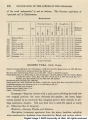
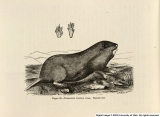
Show 262 EXPLORATION OF THE CANONS OF THE COLORADO. strongly contrasting with the white lining of the pouch. Tail usually more or less like the body. HABITAT.-South Colorado, Southern Utah and Southern Nevada, Western Texas, New Mexico, Arizona, and Lower California to Cape Saint Lucas. Southward extension into Mexico undetermined. "Louisiana.7' Description (from extensive series from the above localities).-No other form of the genus varies so much in color as this one. With the increase in intensity and richness of coloration of the genus to the southward, there is a corresponding ratio of variation to or from what may be held the normal mean. Selecting average samples, as, for instance, some I collected at Fort Whipple, Arizona, in 1864-'65, we observe a very rich tawny or fulvous pelage, more or less obscured on the back by a blackish area. The under parts are of the same color, paler or of about equal intensity, with the deep plumbeous bases of the hairs showing. The ears are set in a small blackish area; the face, and, to a less extent, the top of the head, are blackish, with or without white spots on the lips or chin, contrasting strongly with the white lining of the pouches. The feet are indifferently whitish or dusky; and more or less of the tail is usually colored. Other specimens, by the extinction of the blackish dorsal area, become nearly concolor all over, and of so rich a hue as to almost bear the term golden-brown. There is a great similarity in many cases to the coloration of Jaculus hudsonius or Arvicola aureola. The best-marked samples of this style before me are from Southern Arizona and Cape Saint Lucas, where this appears to prevail. Dr. Woodhouse's type of-" fulvus" is entirely of this color above, with nearly white belly. Specimens from the Colorado Valley exhibit another style of coloration in their extreme pallor, from the bleaching of fulvous into a pale brownish-yellow, and with whitish belly. A specimen from "Sonora" (rather Southern Arizona, as now bounded) is dark-cinnamon or chestnut-red, with blackish dorsal area. More northerly specimens tend to grayer tints; but this grayishness has a plumbeous cast, and is suffused on the sides with tawny. The belly in these cases is as purely hoary-gray as in typical talpoides; and one specimen, from Fort Massachusetts, is exactly rat-colored, and indistinguishable from pure talpoides, except in being smaller, though it is apparently very old. In this specimen, too, the characteristic |