| OCR Text |
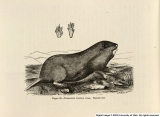
Show 260 EXPLORATION OF THE CANONS OF THE COLORADO. strong wash of tawny or muddy-brown, quite unlike the hoary-gray of the same parts of talpoides. The under surface is not known to be varied with patches of white, nor is there any white about the mouth, excepting the immediate border of the lips. On the contrary, the mouth-parts are sooty or dusky, contrasting with the white which lines the cheek-pouches. This is very much as in umbrinus, and quite different from talpoides. The hands and feet are sometimes white, as in talpoides, but oftener merely whitish, and not seldom dusky. I have not seen the tail pure white; it is generally dark-colored for the most part, often wholly so. The fore claws average about 0.40-rather less than more. Such is the typical manifestation of this form, which I have only seen from California. We have next to trace the change by insensible degrees into both talpoides and umbrinus. Proceeding up the Pacific coast, we find an animal still like bulbivorus in the general tone of coloration (warm-brown above and muddy-bellied), but in which the mouth-parts have nearly or entirely lost their sootiness. Here, also, the fore claws enlarge somewhat, and from this state it is but a step to the grayer true talpoides, which joins with douglasi in the interior of Oregon and Washington. In the interior of California, the opposite modification begins, tending toward umbrinus, which becomes fully established in Arizona and New Mexico. Here the dark mouth-parts are preserved and even intensified, but the color grows richer till a decidedly tawny or fulvous cast is the result. Various specimens from Fort Crook and Fort Tejon, and from Provo, Utah, are of this ambiguous sort, and exhibit among themselves such variations that their labeling becomes a matter of indifference. Some of the browner ones are not separable at all from bulbivorus, while the ruddiness of others matches that of true fulvus. The gradation of the two forms in this region is demonstrable complete. Some other specimens from Fort Crook are absolutely identical with Steilacoom ones in respect of color; the only difference I can note being the somewhat weaker claws. To the southward, on the coast, the same gradation occurs, becoming established about San Diego, In Lower California, pure umbrinus prevails, A San Franciscan specimen lately received at the Smithsonian is a perfect albino-snow-white all over. |