| OCR Text |
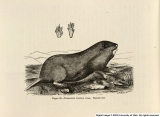
Show 228 EXPLORATION OF THE CANONS OF THE COLORADO. tion indeed, but accompanying it with a grotesque figure from a drawing by Major Davies, representing an amorphous creature with a pair of great skinny, veiny bags hanging loosely from the mouth; the pouches of his specimen having everted, and this being their supposed natural state. The original figure in the Linnaean Transactions is somewhat improved upon in the General Zoology, but is still a very ludicrous object. The animal is said to have come from "Canada," where it was taken by some Indians in 1798, and afterward presented to Governor Prescott's wife. According to the description, the animal was in the plumbago state of pelage. There is no doubt whatever about the species (though some writers have refused to recognize it) ; even the wretched figure in the General Zoology shows the grooved incisors clearly. Moreover, this identical specimen, which once formed part of the Bullock collection in London, and subsequently passed into the hands of Temminck, seems to have been examined both by Kuhl and Lichtenstein; and, at about the same time, each of these naturalists made a new genus for its special benefit, Kuhl calling it Saccophorus bursarius, after Shaw, and Lichtenstein renaming it Ascomys canadensis. This title prevailed with most German authors. Contemporary French authorities considered it a Hamster, and referred it to Cricetus. Say established, in 1823, the genus Pseudostoma, generally accepted by American writers. The original mistake (arising from faulty taxidermy, that prolific source of error with the dermatorpaniacs) of supposing the pouches were pendulous sacs opening into the mouth was scotched several times before it was finally killed. Meanwhile, before Kuhl, Lichtenstein, and Say had severally made their new genera, species of the genus had already entered the peculiar field of vision, or supposed vision, of M. Rafinesque, who furnished two new names. The Dipiostoma of this writer is diagnosticated by an expression few terms of which are founded in fact; for he denies the animal tail, ears, and open eyes, and only credits it with four toes to each foot, whereas it has a tail, ears, open eyes, and five digits before and behind. In the same place, Rafinesque establishes another genus, Geomys, which is based upon fair characters, though there is nothing in them to prove whether he had a Thomomys or a true Geomys in view. The primary reference is, however, to MitchelFs " Hamster of Georgia7' (G. pinetis), which fixes the matter. Rafinesque |