| OCR Text |
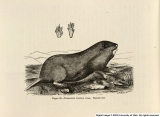
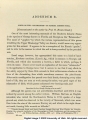
Show COUES ON GEOMYS AND THOMOMYS - T. TALPOIDES. 253 distance.* The upper incisors are smoothly convex on their front face, with a very fine line of impression running immediately along their inner margin. This groove, always delicate and liable to be overlooked, is sometimes obsolete, or, at any rate, fails to run the whole length of the tooth. The inferior incisors are similar, but longer, narrower, and with no sign of a groove. The blunt, tumid snout is entirely hairy, excepting a small nasal pad, strictly confined between the nostrils. The whiskers are very numerous, very fine and soft bristles (mostly colorless), and the longest of them do not equal the head in length. A few slight straggling bristles grow over the eyes and elsewhere about the head. The eyes are situated about midway between the nose and ears; they are small, only about an eighth of an inch in diameter, with rather tumid lids. A notable peculiarity of the species of Thomomys, in comparison with Geomys, is the presence of external ears, about which there is no question. In Geomys, the mere rim of integument warrants use of the terms "rudimentary" or "obsolete." In Thomomys, there is a very evident auricle, which rises behind, something like a quarter of an inch above the head; nor is it a mere rim even of this decided dimension; it tapers to quite a point behind, and the lower border of the conch shows a slight folding, which represents a rudimentary lobule. The cavity of the auricle admits the end of my pen-holder; the external meatus itself would admit a pigeon-quill. In the general shape of the body, there is nothing but what is shared by all the species of the family. The amplitude of the pouches is such that the width across them is much the greatest diameter of the body. The next greatest girth is around the belly; the chest-measure is a little less than this. The fore and hind feet are as nearly as may be of the same length; either may slightly exceed the other, the difference being mainly due to varying development of the fore claws. These, though decidedly fossorial (a family-character), are not so enormously developed as in Geomys bursarius, being decidedly less than half the total length of the hand. The digits have the same relative lengths, taken either with or without their claws: the 3d is longest, with the largest claw; the 2d is next; the 4th next, being about as much shorter than the 2d as this is less than the 3d; the 5th is abruptly much shorter, the tip of its claw scarcely or not reaching the base of the 4th claw; the 1st is shorter still, a mere stump, with a little knob for a claw. * No idea whatever of the true configuration of the mouth-parts in this family can be gained from dried specimens from which the skull and teeth have been removed. . * . |