| OCR Text |
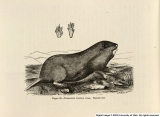
Show 248 EXPLORATION OF THE CANONS OF THE COLORADO. Of these eight species which Professor Baird gave, one, " talpoides," is not really indentified by him, as he only copies Richardson's account; and another, borealis, he says himself he failed to recognize satisfactorily. This leaves only six which he actually indorsed "Borealis" had already been identified by LeConte with rufescens; and the animal I describe as "talpoides" is the same as his under another name, resulting from the identification with it of Richardson's species. Another name is thus diposed of. That Wood-house's "fulvus" is an absolute synonym of what Baird called umbrinus, I have satisfied myself by inspection of his type-specimen. Respecting the Pacific-coast form, it is perfectly easy to trace the complete intergradation between the northern (douglasi) and southern (bulbivorus) extreme. Of "laticeps," no second specimen is known; some of the external characters are altered, apparently, by skinning and drying after immersion in alcohol. In accounts of the species of this genus, much stress has been laid upon size and shape as distinguishing marks, even by those who are fully aware, not only of the high normal variability in these respects, but also of the peculiar susceptibility to overstuffing, and to various distortions of parts. Nowhere else, perhaps, has bad taxidermy made such a break; it is responsible for different genera, to say nothing of various species. The skin of the whole body, like that of the pouch, is extremely distensible, and several inches may be added to the stature of any individual by overstuffing, without leaving any very obvious trace. The peculiar configuration ,of the body at the base of the tail renders nice measurement of that member very difficult. The feet, particularly the fore feet, shrink and cramp in drying, so that neither their size nor their shape can be appreciated. Upon removal of the skull, the mouth-parts infallibly lose all semblance of nature in drying. In Geomys, it is the same; but there the species are so well marked that the worst taxidermy can hardly obscure them. After careful examination of many specimens, fresh, alcoholic, and dried, the following is the full extent of the discriminations I have been able to make: Size.-The Northern Interior form and the Pacific-coast form are of the same size; the Southern Interior form averages an inch or two less in total length than the other; but large specimens of the latter, and small examples of the two former, overlap each other in stature. Form.-The Northern Interior race and the Northern styles of the Pacific- |