| OCR Text |
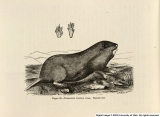
Show 232 EXPLORATION OF THE CANONS OF THE COLORADO. ance; if the vertebrae be left in, it shrinks tightly around them in drying, displaying not only the joints, but also the shape of the individual-bones. The hind feet share this nakedness, but not to the same extent; the instep is nearly bare, but the toes are sparsely pilous with short colorless bristles. The back of the fore feet is in much the same condition. The depilation of the members is not always as complete as here described ; but such is the unmistakable tendency in all cases, and such the accomplished result in the majority of examples in adult life. Younger specimens, in the plumbago state of pelage, show as hairy tail and feet as an average sample of G. bursarius, and before the incisors have attained maturity, so as to afford fair characters, might readily be supposed to be G, bursarius, were locality not taken into account. Of such character is No. 1500, Museum of the Smithsonian Institution, particularly mentioned by Baird, op. cit., p. 382. My material is abundant for a table of measurements of this species; but it seems unnecessary to prepare one, since it would be simply an amplification of the statement that the animal does not differ at all from G. bursarius in size or shape. For the same reason, it is unnecessary to enter into further description after presenting the two characters (particular style of sulcation of incisors and nakedness of tail and feet) in which solely does the species stand apart from G. bursarius. Under these circumstances, it might be held by some that the present is merely a localized race of G. bursarius; and I should be the last one to dispute such statement of an abstract fact. This Geomys is, of course, an offshoot of the bursarius stock; and, for that matter, so are all the rest of the " species "modified descendants of some one stock. It would be only shifting the question a peg to require that the fact should affect the nomenclature. A "permanent variety" is a contradiction in terms. This is the case: Here is a set of individuals differing thus-and-thus (as above described) from another set. The difference is slight, but constant; there is no intergradation, for the simple reason that the two sets of animals now occupy different geographical areas, are completely isolated from each other, and thus cut off from interbreeding; or, in other words, from reproducing offspring in which the characters of both parents are blended. It is quite possible that, in their blind movements under the ground, the two may come together and interbreed |