| OCR Text |
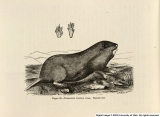
Show COUES ON GEOMYS AND THOMOMYS - G. BURSARIUS. 229 gives a number of species of each of his two genera. Twelve years subsequently, in 1829, Dr. Eichardson discussed RafinesqueV names, coming to the erroneous conclusion that they both represented good genera, in one of which the cheek-pouches opened into the mouth, these being wholly external in the other. He describes several new species of Thomomys under the name of Geomys, supposing them to all have pendulous pouches; gives the present as-Geomys^ bursarius; and refers one Thomomys to Diplostoma, having satisfied himself of the true state of the case in this instance. The Mus ludovicianus of Ord (1815) is a name which may be supposed to refer to this species, but it is probably not determinable, and in any event is antedated. Dr. Mitchill named the species Mus saccatus in 1821. The only late synonyms I have met with are oregonensis of LeConte and breviceps of Baird. LeConte, indeed, in his excellent sketch of the family, which placed the group upon a far more satisfactory footing than that it had previously occupied, calls it Geomys canadensis; but this is merely the restoration of Rafi-nesque's generic name, coupled with Lichtenstein's specific one, upon the presumption that the faulty Mus bursarius of Shaw ought not to be recognized. Dr. LeConte's oregonensis is founded upon an animal said to be from Oregon; but this locality is doubtless erroneous, for, as now well known, Townsend collected all the way from the Missouri westward, though his specimens fell in the way of being marked "Columbia River/7 or "Oregon," with little regard for actual localities where procured. The name oregonensis, besides being geographically erroneous in all probability (no Geomys is known to occur west of the Rocky Mountains), rests upon characters not in the least incompatible with the now known G\ bursarius. The types of G. breviceps now before me are all smaller than average bursarius, but within the range of variation of that species; and I fail to substantiate any tangible characters by which this supposed species may be held to be distinct. ; The English name of "gopher,'7 applied to this and other species of the family, is evidently a corruption of the French term "gaufre," given by Canadian voyageurs. It re-appears in German as Goffer. In the West, where the Spermophili are universally called gophers by hunters and settlers, the/ species of this family are distinguished as " pocket-gophers." The application^ |