| OCR Text |
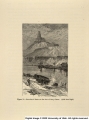
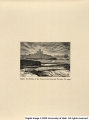
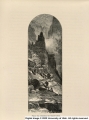
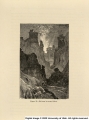
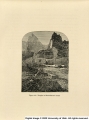
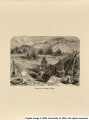
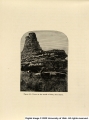
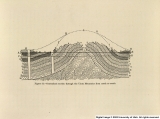
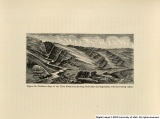
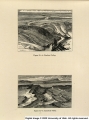
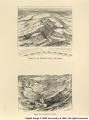
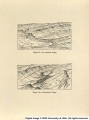
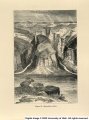
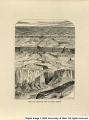
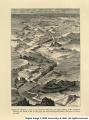
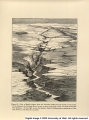
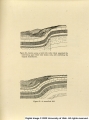
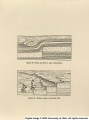
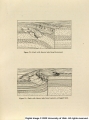
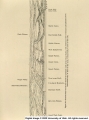
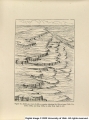
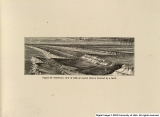
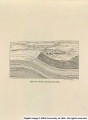
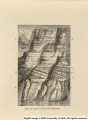
Show 192 EXPLORATION OF THE CANONS OF THE COLORADO. 76 is a cross section, intended to represent the structure of these interesting cliffs. In some places, the erosion of the western escarpment has been carried back farther than the line of displacement; in other places, not quite up to it. But wherever the line of erosion has been brought up to the line of displacement, or near it, we find the rocks standing in sharp crags. I have heretofore explained that one of the conditions essential to the cliff structure is that the beds of the summit must be comparatively hard, and the beds below, at the foot of the cliffs, very soft; and this condition is well illustrated in these cliffs. Now the lower beds are turned down, by the monoclinal fold, below the reach of the waters employed iii degradation, as you pass across the fold from west to east, and hence these cliffs cannot be carried farther to the east, by the progress of undermining, as long as the present conditions exist; and now the agency of erosion can only be exerted in obliterating the ridge. For this reason the ridge disappears in those places along its line where the undermining erosion from the west has progressed the farthest. . On the western side of the Paria Plateau there is an escarpment, facing the west, due to erosion, and the line of the escarpment, on its northern end, coincides with the line of flexure of the Eastern Kaibab Fault. Here, again, we have a line of crags or peaks, forming an irregular ridge, like that in the Echo Cliffs; but this stands on the brink of a well defined plateau, and is higher than the general surface of the table. The crags and peaks are carved from the upturned edges of the beds. The slope due to displacement is seen farther to the west, and is the slope of the Kaibab Plateau, and faces the escarpment. Only a small portion of this slope is seen in the edge of the plateau, where stands the line of crags. The softer beds at the bottom, which constitute one of the conditions on which the escarpment depends, are still exposed to the action of rains and streams, and the cliff condition is not terminated, as in the section previously given, and future erosion will carry this line of cliffs back to the east, as long as the present conditions are preserved.- :.:\- ,j . . •..:>::. ; : •./' ;-/.;.:,..,'''"-..' •'- :•'.•-'-•'"••''• ••-••••• :f ^ •:^"^^ --^'-':•:•• \ l Figure 77 is a section extending from the Paria Plateau, on the east, across House Rock Valley, to the Kaibab Plateau, on the west, and shows the upturned edges of the rocks on the brink of the Paria Plateau. The |