| OCR Text |
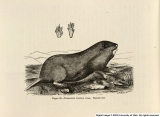
Show 242 EXPLORATION OF THE CANONS OF THE COLORADO. only three pairs of teats-two pairs inguinal, and one pair, longo intervallo, pectoral. These are very conspicuous, on naked scabrous spaces, and the thin coarse fur would hardly, I think, hide others if they were present. In some species of this family I have distinctly recognized six pairs. I observe no sexual peculiarities in size or color. The geographical distribution of the species has been already indicated as far as my present materials go. I am in possession of no information respecting its habits, which, however, may be presumed to be the same as those of its congeners; though the weaker feet and proportionally smaller pouches may indicate that the fossorial character is not pushed to such an extreme as is the case with G. bursarius. The written history of the species is brief and precise; the name having been only introduced in 1852. Audubon and Bach man's account is from Le Conte, and Baird redescribes LeConte s type. It is quite possible, and, indeed, probable, that this second Mexican species has figured at times under the name of mexicanus, but it would only tend to obscure a matter now clear to drag any such point to light. Now that we know of two perfectly good species in Mexico, the less said about the Tucan of Hernandez, or any similar subsequent uncertainties, the better. A Saccophorus quachil, from Guatemala, was named by Dr. Gray in 1843, though I cannot find that the species was ever described. But through the kind offices of Mr. B,. B. Sharpe, who, with the assistance of Mr. Gerrard, examined the type still in the British Museum, at my request, I am informed that it is the animal first described, though subsequently named, by Dr. LeConte. The foregoing pages include all the species of Geomys with which I am acquainted, and account probably for all the names which have been introduced excepting one, G. heterodus, recently described, from Central America, by Professor Peters, of which I know nothing. ("Uber neue Arten der Saugthier-Gattungen Geomys, Haplodon und Dasypus." < Monatsberichte Acad. Wissensch. Berlin, 1864, Mar. 17, pp. 177-180.) |