| OCR Text |
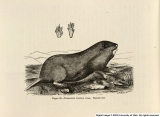
Show 234 EXPLORATION OF THE CANONS OF THE COLORADO. tail sparsely pilous. Color pale yellowish-brown above, inclining more or less to dull chestnut about the head ; whitish below. Size of G. bursarius, or rather less. Fur soft, as usual in the genus. HABITAT.-Texas and New Mexico. Description (from Baird's types of G. castanops and G. clarkii, and other specimens).-This remarkable species is immediately distinguished from all others known to me by the combination of a single median groove of the incisors, pale light color, and small size. In the first-named particular alone, it agrees with G. mexicanus; in both these species, the single groove is central, bisecting the surface, so that, viewed from the front, there appear to be four incisors. This at once and permanently separates it from G. bursarius, with which it is to be compared in other respects. In size, the five specimens before me average about the same as G. bursarius, though none are as large as the largest of the latter I have seen. The length of the full-grown animal may be about 8 inches, rather less than more; and some are not much over 6 inches. The tail, as well as can be judged, is 2J to 3 inches. A notable peculiarity of form, in comparison with G. bursarius, lies in the relative proportions of the fore and hind feet, which are much as in GG. mexicanus and hispidus; the palm, with the length of claws included, being shorter, or, at most no longer, than the sole and claws; the latter measuring about 1J inches, the former only about 1^ inches. The fore claws are, however, well developed proportionally, no difference in this respect from G. bursarius being readily appreciable. The external ears may fairly be called obsolete; in neither of the specimens can I make out anything more than a thickened rim surrounding the orifice of the meatus. The hairiness of the tail and hind feet is pretty much as in an average specimen of G. bursarius or G. mexicanus; they are thinly clothed indeed, but noticeably more so than is ever the case with G. tuza or G. hispidus. The pouches are somewhat less ample, apparently, than in G. bursarius-a character coordinated in this genus with weaker fore feet, and seen also in G. mexicanus and G. hispidus. The coloration merits particular attention, not only as it is the next to the strongest character of the species, but because a casual phase of it was the basis of the original Pseudostoma castanops. It might seem surprising, and certainly it would be contrary to analogy, that a single species of this uni- |