| OCR Text |
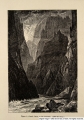
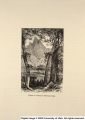
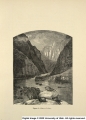
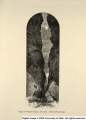
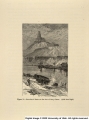
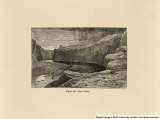
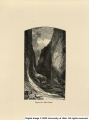
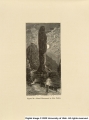
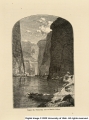
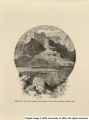
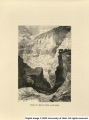
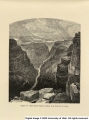
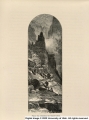
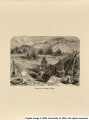
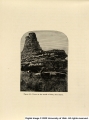
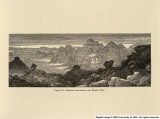
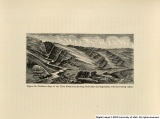
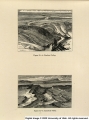
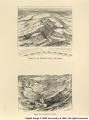
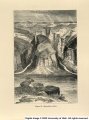
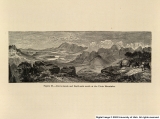
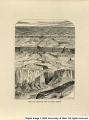
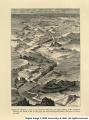
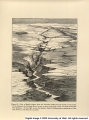
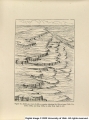
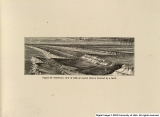
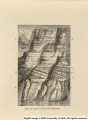
Show PAUNS-A'-GUNT PLATEAU. 135 sand, with continually changing boundaries, in some places burying trees and rocks; in others heaped in huge drifts* * North of our camp, and eight miles distant, the south end of the table land known as the Pauns-a'-gunt Plateau rose to an altitude which we determined to be 3,295 feet above our camp, or about nine thousand two hundred feet above sea level. The eastern boundary of this plateau is a line of cliffs, having a general trend north 45° east. These cliffs show in the distance a beautiful pink color, and, for the upper 2,000 feet, present bold, perpendicular faces, with here and there steep, rocky slopes. From the foot of these slopes and vertical faces long, narrow ridges run out on the plain below. Between these ridges are many beautiful valleys, but probably the whole country is too much elevated for permanent settlement. From Camp No. 3 to Camp No. 4 our course was northeast. Camp No. 4 was in a beautiful, grassy valley, half a mile wide and six miles long, lying between two cedar covered ridges. At its foot, a small lake stands at the entrance of a narrow canon, that drains the valley, and cuts its way through both the White and Vermilion Cliffs, furnishing, as we determined by exploration, another practicable route through these escarpments to the valley connecting the Kanab and Paria settlements. From Camp No. 4 to Camp No. 5 our course was nearly northeast. For four miles we passed over low, grass covered ridges, when we came to the brink of a basin like region, drained bv the head waters of the Paria o / «/ River. The extension of the White Cliffs to the east forms the southern boundary of this basin, and the*Pink Cliffs (forming the eastern face of the Pauns-a' -gunt Plateau, and here swinging in a great curve to the north) the northern. From underneath the cliffs standing around the northern rim of this basin many springs burst forth. These gather at first into five considerable streams, which, uniting near the southern limit of the basin, form the Paria River, and cut through the White and Vermilion Cliffs in deep canons. In the soft, easily eroded rock within this basin each of these five streams has cut a deep, narrow canon. Literally, hundreds of side canons are tributary to these. Between the side canons stand long, narrow mesas. Sometimes the canon is cut two or three hundred feet, and then, in its floor, a still |