| OCR Text |
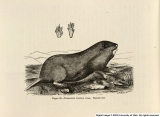
Show COUES ON GEOMYS AND THOMOMYS - G. MEXICANUS. 237 grown, about 10 inches from nose to root of tail. Tail about 3 inches from its apparent base (LeConte gives its length as 5 inches); sole, somewhat cramped, apparently 1.50; hand, much cramped, estimated to be about the same, or rather less. Nose to eye about 1.35. Girth of body 8 or 9 inches. The pouches, as well as can be judged from the skin, are smaller proportionally than those of the United States species; in this respect, being like those of G. hispidus. These two Mexican species further agree in the relative srnallness of the hands and less enormous development of the claws ; the fore member being shorter, or, at most, not longer, than the hinder one. The vesture of the feet and tail is much the same in extent as in bursarius, and thus in striking contrast to those parts in either G. tuza or (?. hispidus. The orifice of the external ear presents, in the dried state, a mere rim, around which no flap can be fairly recognized. It seems preferable thus to describe this species in comparative terms to bring out the curious interrelations of the animal-a species with the size and single incisor-furrow of G. hispidus, yet the furrow different in position, and the pelage altogether different. Agreeing in the points of character of pelage, its color, and amount of hairiness of tail and feet with G. bursarius, yet at once distinguished by its superior size and single median furrow of the upper front teeth; exactly like G. castanops in this last respect, and in most others, yet entirely of a different color; disagreeing with all the United States species in its smaller pouches and weaker hands, and in these points agreeing with its very distinct Mexican congener. As regards color: LeConte's animal, "which agrees with Lichtenstein's and Wagner's descriptions," and is called "saturate cinereus, supra nigro-tinctus, naso brunneo" was evidently an example of the ^plumbagos-colored variation, which may occur in any species of this genus as well as in Thomomys. The specimen before me is of the normal coloration; and this cannot readily be characterized as anything decidedly different from ordinary bursarius, though there is a purity of the chestnut-brown which contrasts with the muddy brown (in some cases almost a glaucous shade or "bloom") commonly seen in bur-sarius. All the fur is deep plumbeous basally, pointed with the warm brown on the upper parts, and only partially hidden below by muddy gray and hoary ends of the hairs. There is a darkness about the auricular region. The hind |