| OCR Text |
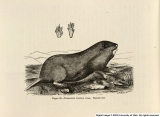
Show 252 EXPLORATION OF THE CANONS OF THE COLORADO. border of Dakota-the details of external form checked from alcoholic specimens from Fort Bridger; in the latter respects, the account represents an amplification of the generic characters, and serves as a standard of comparison for the other species, in the account of which these full details need not be repeated).-So close is the general resemblance of this animal to Geomy? bursarius that, when the incisors are not examined, a second glance is required to distinguish them. The most obvious points of difference are the much smaller and weaker fore claws, altogether less mole-like (spade-like) hands, and the decided though small external ears. The cheek-pouches are ample- if anything, more capacious than in Geomys bursarius or tuza, and very decidedly larger than in other species of that genus. They extend fairly past (over) the shoulders to a point about opposite the elbow, when the fore limb is in a usual position. In comparison with species of its own genus, there are, in T. talpoides, absolutely no decided points of difference in form. With very little modification in some details, one description is equally applicable to them all, excepting T. clusius, in which there are tangible distinctions. The general arrangement of the mouth-parts is as in Geomys bursarius. Beneath the whisker-patch, on each side of the muzzle, about half-way from nose to eye, the fold of skin arises and curves loosely around, to subside again in the common integument over the posterior angle of the under jaw. In a full-grown animal, the slit is an inch and a half long; the " slack>? of the edge of the pouch may be pushed an inch or more away from the cheek; the amplification of the sac is here at a maximum-it reaches past the shoulder, as already said, and, in a full-grown animal, two fingers may be inserted to the second joint. The arrangement of the immediate mouth-parts is such that, as in Geomys, the mouth appears to be a vertical fissure instead of a horizontal one, bounded on either side by thick, fleshy, and. hairy lips. This, however, is only the vestibule of the mouth; the buccal orifice proper being small, closing horizontally of course, as usual, remote from the upper incisors, which are shut out completely by a long, vaulted, hairy interval. The mucous membrane of the cheeks only fairly reaches the edge of the lips in a small patch on either side, and iust in advance of the under incisors. Besides the general hairiness of the buccal vestibule, there are longer and more bristly hairs, depending like a fringe around the roots of the incisors, and margining the false lips for some |