| OCR Text |
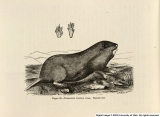
Show 264 EXPLORATION OF THE CANONS OF THE COLORADO. longest under 0.30. Incisors as usual in the genus. Muzzle almost entirely hairy, with a very small naked pad confined between the nostrils. Pouches ample, about 1.75 deep (measured from the beginning of the fold of skin at the side of the snout). Tail extremely short; under 1.50 in length from the true base, and little over 1.00 from the end of the conical enlargement at base; the thinly-haired portion being thus less than one-fourth the total length of head and body. Ears minute. Color above pale yellowish-gray, with a slight light-brown shade; the fur plumbeous at base, as usual. Below, nearly pure white, the fur being mostly of this color to the very base. No dark auricular area. Feet and tail white. Extremity of snout blackish, Claws and whiskers colorless. Incisors faced with orange. HABITAT.-The single specimen of the species at present known, No. 3051, Museum of the Smithsonian Institution, was taken at Bridgets Pass, Rocky Mountains, July 28, 1857, by Dr. W. A. Hammond. With only one specimen to go upon, there is little to be added to the foregoing diagnosis. That the small size is not due to immaturity is evidenced by the fact that the specimen is a female, with functionally-developed teats, which had been in use. As well as I can determine from the dried skin, there are twelve mammae,* situated as in T. talpoides. In its present state, somewhat stretched, the skin measures about 5J inches from nose to root of tail. The general dimensions, as well as the relative and absolute length of tail and the proportions of the feet, are all quite beyond the utmost limit of variation determined for any other form of Thomomys. It may give an idea of the smallness of the feet to say that the hind ones are no larger than those of the white-footed mouse (Hesperomys leucopus) ; they are a trifle broader, but not quite so long. The fore feet are decidedly shorter than the hinder ones, owing to the slight development of the slender weak claws. The ears are minute-scarcely larger, comparatively, than in a Geomys, though the tiny auricle has the recognizable shape of Thomomys, instead of being a mere tumid rim. The tail, as well as can be guessed from the present dried state, is less than a fourth as long as the head and body, measured from its apparent base. All these characters are utterly incompatible with any variety * This appears to be the normal number in this genus; but, in an alcoholic specimen of talpoides, with the fur all gone from the belly, completely exposing the parts, I can find but eight; the two axillary pairs being wanting. |