| OCR Text |
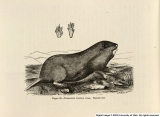
Show 218 EXPLORATION OF THE CANONS OF THE COLORADO. most nearly allied, family. The SaccomyldcB are extremely lithe, agile, graceful animals; jerboa-like, with long saltatorial hind limbs, elongated and often tufted tail, large ears, and full eyes, and are not specially nocturnal or subterranean in habits. The Geomyida, on the other hand, are hamster-like, or rather an exaggeration of that kind of structure ; they are among the heaviest for their inches of any animals of this country, of squat, bunchy shape, with short, thick limbs, a short tail, very small or rudimentary ears, small eyes, no appreciable neck, and thick, blunt head; and they are as completely subterranean as the mole itself. They are rarely and only momentarily seen above ground; they excavate endless galleries in the earth in their search for food, frequently coming to the surface to throw out the earth in heaps, but plugging up these orifices as soon as they have served their purpose. Both families agree in possessing enormous cheek-pouches, overlying the whole side of the head, in some species even reaching over the neck and shoulders. The nature and construction of these sacs was long misunderstood. They were supposed for many years to be external pendulous bags opening into the mouth, and thus to differ only in degree of development from the ordinary "cheek-pouches" of many other rodents-an enlargement of the mucous membrane of the mouth and skin of the cheeks. But, as now well known, they have no connection with the mouth; at least, no more than the abdominal pocket of an opossum has with the genitalia. Their chief purpose is not even related to the food of the species; they are sacs that the animals use chiefly in carrying out dirt from their burrows to deposit it on the surface of the ground. They are fully described beyond. Several circumstances have conspired to obscure the history of the Geomyida, and to involve the determination of the species in doubt. In the first place, the animals are largely withdrawn from ordinary observation, and the acquisition of specimens is difficult. Their geographical distribution is limited to a portion of America. Very few specimens, comparatively, have ever reached Europe, and very few foreign naturalists have written about them from anything like sufficient means of observation. In fact, they are among the rarest sets of specimens in any museums; and I think it probable that there are before me, as I write, more prepared specimens than have before been examined by all naturalists put together. This shows the |