| OCR Text |
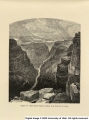
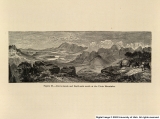
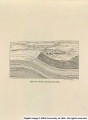
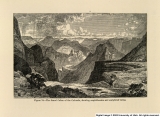
Show ANTECEDENT AND CONSEQUENT VALLEYS. 163 moisture, and a greater quantity of rain falls on them, or in their vicinity. The region of country adjacent to the mountains receives a portion of this extra rain-fall, so that this dynamic agency increases from the plains to the summits of the mountains, probably in some direct ratio. This increase of the eroding agency, and the greater exposure of the soft beds, probably accounts for the fact that the lowest country is at tho foot of the mountains. There is a limit to the effect of these conditions, for it should be observed no valley can be eroded below the level of the principal stream, which carries away the products of its surface degradation; and where the floor of such a valley has been cut down nearly to the level of such a stream, it receives the debris of the adjacent cliffs and mountains, and in this way the rocks composing the floor are usually masked, to a greater or lesser extent. The same topographic facts, under like conditions, are found on the eastern slope of the Rocky Mountains, in Colorado Territory, and the valleys which run into the South Platte from the south, between the hogbacks, are lower than the mesas and plateaus farther away from the mountains, but not lower than the flood plain of the river. I have endeavored above to explain the relation of the valleys of the Uinta Mountains to the stratigraphy, or structural geology, of the region, and, further, to state the conclusion reached, that the drainage was established antecedent to the corrugation or displacement of the beds by faulting and folding. I propose to call such valleys, including the orders and varieties before mentioned, antecedent valleys. In other parts of the mountain region of the west, valleys are found having directions dependent on corrugation. I propose to call these consequent valleys. Such valleys have been observed only in limited areas, and have not been thoroughly studied, ancl I omit further discussion of them. In the great rnetamorphic belt extending through the Territory of Colorado, comprising the Rocky Mountain chain of this Territory, the structural geology is exceedingly complex, while the drainage is comparatively simple, and only to a limited .extent does it seem to be governed by geological structure. The conclusions to which I arrived were that the present drainage was established in rocks now carried away from the higher regions, but still seen to be turned up against the flanks of most of the ranges. |