| OCR Text |
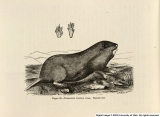
Show 240 EXPLORATION OF THE CANONS OF THE COLORADO. described in this paper. The teeth of old animals are also of immense size, suggesting a beaver or porcupine; the under incisors sometimes protrude nearly an inch, while the upper ones are exposed for over half an inch. The next most notable feature is the nakedness of the tail and feet. The tail, in extreme cases, is absolutely bare-not a hair or bristle can be discerned, even on holding the specimen up to the light, except upon the enlarged base In these cases, the hind feet, from the tarso-metatarsal joint outward, are nearly bare, though a few bristly hairs may be observed, especially on the toes. The hands share the same nakedness, but in less degree; their backs are sparsely clothed with bristly hairs, indeed, but not in sufficient quantity to conceal the skin; a slight stiff fringe of hairs overhangs the inner border. Specimens vary in these respects; in some, delicate bristles, scarcely visible except when held up to a light, are scattered over the tail, and more evident ones clothe the instep. But the parts are never fairly hairy, as in mexicanus, always presenting a peculiar skinny appearance. There are additional characters, aside from size and color. The very short tail is less than one-fourth as long as the head and body. Owing, in part, to a less development of the fore claws, the hands are not as long as the feet. The longest third claw before me is only exserted three-fourths of an inch, and it is usually shorter than this. The second and fourth claws are sub-equal to each other. The whole hand is smaller and weaker than in the G. bur-sarius group, indicating less fossorial nature; and coincidently with this-perhaps in correspondence with it-the cheek-pouches are not so highly-developed. As well as can be judged from prepared skins, the sacs do not reach beyond the head-certainly not to the shoulder; their capacity, in an individual nearly a foot long, seems no greater than that of specimens of G. bursarius eight inches long, and not more than half as bulky. The hispid pelage is a remarkable feature; this is so strong a character that the species may readily be diagnosticated in the dark by the "feel" of the fur, and it is instantly noted in comparison with any of the other species, in which the pelage is sleek and soft, much like a mole's. Besides being so coarse and harsh, and almost entirely lusterless, it is longer than usual, and interspersed with still longer and almost bristly hairs. There is no perceptible under-fur different from the general pelage; and the color is uniform to |