| OCR Text |
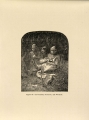
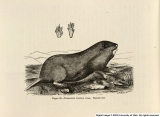
Show 282 EXPLORATION OF THE CANONS OF THE COLORADO. A brief description of the species, under the name of the Hamster of Georgia, was published in the New York Medical Repository in 1802, and afterward in an appendix to the American edition of Bewick's Quadrupeds. On this description was founded the name Mus tuza, cited in the list of American mammals published by Ord in 1815,* a name which antedates that of Rafinesque by about two years, and which has been adopted by Dr. Coues. Notwithstanding their great abundance, it is extremely difficult to obtain specimens of the salamanders. Their acute sense of smell gives them an early warning of the approach of danger, and they easily make their escape in the maze of tunnels. Should one even be driven into a blind passage, it would find little difficulty in baffling its pursuer, for it can burrow faster than a man can follow with a spade; and, since it obliterates its track by throwing the soil behind, it leaves scarcely more trace of its passage in the loose sand than a fish swimming through the water. It is thought quite impossible to dig them out. Occasionally, they are shot, when they come to the surface to throw out sand; but they remain in sight only an instant, and the marksman, to be successful, must have his gun bearing upon the opening at which the animal is expected to appear, with finger on the trigger, and be ready to pull the moment the head is sighted. By the patient use of steel-traps, while in Florida this spring, I obtained a number of specimens, some of which I succeeded in keeping for several weeks, thus having an excellent opportunity of studying their habits.f They may easily be confined in a wooden box, with sides eight or ten inches hio-h " & ? having dry sand two or three inches deep on the bottom. No cover is necessary; I have never seen one look up from the earth, and have rarely •• known them to attempt to escape. They require no water, and no food except sweet-potatoes. A single potato of moderate size will feed a salamander for three days. The senses of sight and hearing seem in them to be very dull. An object may be held within a short distance of their eyes without attract- * Outline's Geography, 2d American edition, ii, 1815, p. 292. t Two of them, which I sent to the Zoological Society of Philadelphia, may be seen in the garden at Fair mount Park. |