| OCR Text |
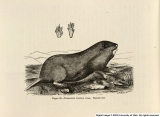
Show 284 EXPLORATION OF THE CANONS OF THE COLORADO. could tell exactly what the salamander does at the instant he appeared, his motions being so quick that one cannot be quite sure; the general impression, however, is, that they are unloading their cheek-pouches. This is not at all improbable, for we know that they carry their food in these receptacles, and it seems a very natural way for them to bring their refuse sand to the surface, since they often have to transport it a distance of several feet. Still it is quite desirable to have other and more careful observations; for observers are apt to be deceived by their own eyes, especially in the light of preconceived opinions. The subterranean labyrinth constructed by this clever army of sappers and miners penetrates the pine-barrens and cultivated fields in every direction. An energetic salamander, with a slight knowledge of engineering, would find little difficulty, I suspect, in making an underground journey through Florida from the Atlantic to the Gulf of Mexico. The direction of the burrows may easily be traced by the loose hillocks of white sand which are thrown up along the line at intervals of three or four feet. These are the "dumps" made by the burrower in throwing out his refuse accumulations. Each consists of about a peck of loose sand, and, by the casual observer, might easily be mistaken for an ant-hill. No opening is visible, but by digging under the Hill a hole is found, the mouth of the adit to the main tunnel, which may be three feet below the surface if made in cold weather, but perhaps not more than six inches if in summer. One of these mounds is thrown up in a very few moments; I have seen thirty raised in a single night on the line of one tunnel; this would represent nearly one hundred feet of tunneling. I have seen one hundred and fifty in one continuous row raised in about two days; this would make between four and five hundred feet of burrow completed in that short time apparently by one little animal, an amount of work which may seem incredible to one who has not watched the restless movements of these animated plows, which are seemingly as well adapted for piercing the sand as birds are for cleaving the air. The burrows are about two and one-half inches in diameter, barely large enough to admit a man's hand, and, as has been stated, are at various depths below the surface. They meander in all directions, except in straight lines; their builders being guided apparently only by their whims or their olfactories. They, no doubt, intersect each other at many |