| OCR Text |
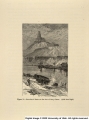
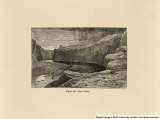
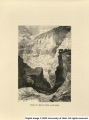
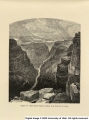
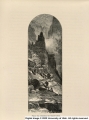
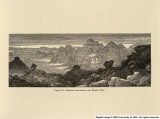
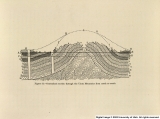
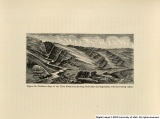
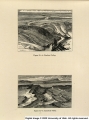
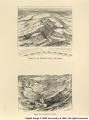
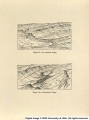
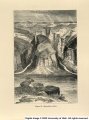
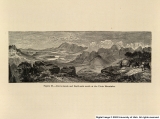
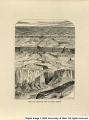
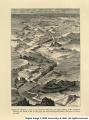
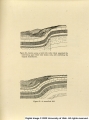
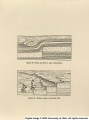
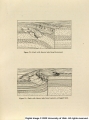
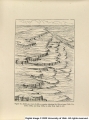
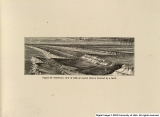
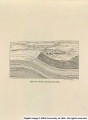
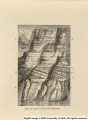
Show 172 EXPLORATION OF THE CANONS OF THE COLORADO. little faster than the degradation of its surface, but, as it comes up, the wearing away is extended still farther out on the flanks, and the same beds are attacked in the new land which have already been carried away nearer the center of the fold. In this way the action of erosion is continued on the same bed from the up-turned axis toward the down-turned axis, and it may and does often happen that any particular bed may be entirely carried away, with many underlying rocks, near the former line, before it is attacked near the latter. Now, as the beds are of heterogeneous structures, some hard and others soft, the harder beds withstand the action of the storms, while the softer beds are rapidly carried away. The manner in which these beds are degraded is very different. The softer are washed from the top, but the harder are little affected by the direct action of the waters-they are torn down by another process. As the softer beds disappear, the harder are undermined, and are constantly breaking down; are crushed, more or less, by the fall, and scattered over, and mingled with the softer beds, and are carried away with them. But the progress of this undermining and digging down of the cliff is parallel with the upturned axis of the fold, so that the cliffs face such an axis. When the fold is abrupt, so that the rocks on either side are made to incline at a great angle, ridges are formed, and this topographic structure of a country may be found even in a land of rains, though the ridges will usually be low, rounded, and more or less irregular, while in a dry climate they will be steep and regular, and will usually culminate above in a sharp edge; but where the rocks are slightly inclined, terraces will be formed, with well defined escarpments. It is interesting to note the manner in which the textures of these hard capping rocks affect the contours of the cliffs. When the hard rocks are separated into well defined layers, or beds, the cliffs will be more or less terraced, as the strata vary in hardness. This is well seen in the Brown Cliffs and the upper portion of the Book Cliffs. In the last mentioned escarpment the harder beds are underlaid by soft, bluish shales, which appear below in the beautifully carved buttresses. In the Orange Cliffs there are a thousand feet of homogeneous light red sandstone, and this is underlaid by beds of darker red, chocolate, and |