| OCR Text |
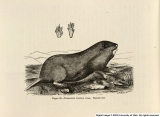
Show 238 EXPLORATION OF THE CANONS OF THE COLORADO. feet and tail are mostly whitish (as is always liable to be the case in Geomys). There is some whitishness about the lower jaw, and a small white abdominal and anal patch; these last being of the irregular indeterminate character often seen in and out of this genus. . This specimen corresponds exactly with Brants's diagnosis of his var. /?. of mexicanus-" castaneus, infra canescens, maculis auricularibus duabus nigro-fuscis" The same author's var. y. suggests hispidus; but it is as well not to strain a point here; for injudicious scrutiny of some of the printed matter extant upon the subject of mexicanus might raise synonymatic difficulty with hispidus. Owing to insufficiency of material, I am not prepared to pursue the subject of the characters of mexicanus into the details of variation in size and color; but I have no doubt that it corresponds with G. bursarius in these respects. The specimen shows three pairs of mammae-two of which are inguinal and close together along the inside of the thigh, the third being pectoral, at a considerable distance; I can find none between. This animal is supposed to be the Tucan of Hernandez, with much probability; and, if so, it was the first of the genus to appear in print. It does not appear, however, to have received a scientific designation, or to have properly entered upon record until many years after "Mus bursarius" had become known, when, in 1827, it was called Ascomys mexicanus by Lichtenstein. I have met with no specific synonyms, though it has been referred to various genera. As the Tuza or Tu9a of the Mexicans, it is treated at some length in the inedited MSS. of Dr. Berlandier, who, after a good description, says that it was supposed by Mocinno and Sess^ (ined.) to be the Mus citillus of Linnaeus, and that it is the Taupe mexicaine of which Clavigero speaks. "It is destructive in the fields by riddling the ground .... it brings up earth in its pouches, and empties them with its fore feet;" and he adds that it inhabits the cold and temperate regions of New Spain, and that he never saw the Tuza in places where there were squirrels, It is not to be inferred that its habits are in any wise different from those of G. bursarius. |