| OCR Text |
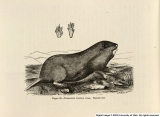
Show GOODE ON THE HABITS OF GEOMYS TUZA. 283 ing their attention; but the moment one is touched, he turns with a jump, snapping fiercely, much to the detriment of fingers which may be near. If two are confined in the same cage, the one does not seem aware of the presence of the other, unless they accidentally come in contact. Their eyes are small, dull, and without expression. Their sense of smell I judge to be very delicate, from the manner in which they approach the hills of potatoes. Their motions are surprisingly quick and energetic; their activity never ceasing from morning to night. They are very pugnacious, and a rough-and-tumble combat between two vigorous males would seem terrific, if their size could be magnified a few diameters in the eye of the spectator. Every muscle of their compact, elastic, stout bodies is brought into action, and they plunge and bite with wonderful ferocity. A battle is usually followed by the death of one or both. I have examined them after death, and found the whole anterior part of the body bruised almost to the consistency of paste, the bones of the legs crushed in four or five places. When two come together in the cage, their salutation is a plunge and a bite. I watched their burrowing with much interest. They dig by grubbing with the nose and a rapid shoveling with the long, curved fore paws, assisted by the pushing of the hind feet, which remove the dirt from beneath the body and propel it back with great power a distance of eight or ten inches. When a small quantity of earth has accumulated in the rear of the miner, around he whirls, with a vigorous flirt of the tail, and joining fore paws before his nose, he transmutes himself into a sort of wheelbarrow, pushing the dirt before him to a convenient distance, and repeating the act until the accumulation is removed, then resuming his mining. Any root or twig which blocks his way is quickly divided by his sharp chisel-teeth. I have never seen a salamander place sand in his cheek-pouches, though I have watched their burrowing hour after hour. It is, of course, impossible to observe them when at work under ground, but I incline to believe that most of the refuse earth from the burrows is transported in the manner just described. The negroes told me that they had seen the salamander appear at the mouth of its hole for an instant and "spit out" the sand which it carried in its pouches, aiding the act by inserting the fore paws into the pockets. I have never met any one who |