| OCR Text |
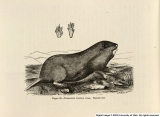
Show COUES ON GEOMYS AND THOMOMYS - T. CLUSIUS. 263 markings of the mouth-parts and pouches are much obscured, and the fore claws are fully as long as in some northern examples of talpoides. Half-grown specimens, as elsewhere in the family, are lead-colored, merely paler below. A melanistic specimen from Cantonment Burgwyii, New Mexico, is a uniform, intense, lustrous plumbago color (almost like anthracite coal), with white lips and pouches. In this form, which exhibits such variation as well as intensity of color, we observe more clearly than elsewhere the changes produced in the shedding and renewal of the pelage. It seems to be the rule in this genus, as in Geomys, that the hair is cast from before backward by a regular progression. As already hinted, the animals appear to grow gray writh age; but, besides this, each annual or seasonal coat seems to lose its richness of coloration toward the time that it is to fall off, and the fresh coat comes out more heavily tinted. It results from this, in connection with the peculiar mode of shedding, that patchy specimens are of frequent occurrence, with a sharp line of demarkation between differently-colored areas (Geomys castanops is a notable case of this). Some examples before me are, in fact, strong " umbrinus?> in front and very fair "bulbivorus" behind. Season, as well as age, doubtless influences the color of the pelage, but exactly to what extent I am unable to say, owing to the usual oversight of collectors in neglecting to date their labels. The geographical distribution of the species, as far as now known, is indicated in a preceding paragraph. The original locality given for umbrinus has not been checked by subsequent accounts, and is probably somewhat out^ of the way; Texas or New Mexico being more likely the source of the type-specimen described by Richardson. I see no occasion to question Baird's identification of the species, with which the Geomys fulvus of Woodhouse is indisputably identical. THOMOMYS CLUSIUS, Coues, nov. sp. SP. CHAR.-Smallest known species of the genus. Length ( 9, adult) about 5 inches. Feet remarkably small; sole of hind foot 0.75; palm of hand, including longest claw, 0.65. Fore claws small, weak, little curved, the |