| OCR Text |
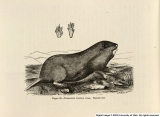
Show COUES ON GEOMYS AND THOMOMYS - T. TALPOIDES. 257 The most northern specimen I have seen is from the Assiniboine River; the species is supposed to range from Hudson's Bay to the Rocky Mountains in British America (northern limit unknown). In the United States, I have specimens from Minnesota, Dakota, Montana, Idaho, Nebraska, Wyoming, Nevada, and Utah. The southern limit is likewise unknown, but inferred to be somewhere along the middle of the United States. Its range, probably, does not inosculate with that of T. umbrinus; at any rate, I have seen nothing intermediate in character from anywhere in the Interior. The approach to umbrinus seems to be only made in the Pacific province, through bulbivorus. Talpoides exists fairly westward of the main chains of the Rocky Mountains; but no Thomomys of this style is known from immediate Pacific slopes. It meets and inosculates with the Northern style of bulbivorus ("douglasi'') in the Columbia River region. Synonymy. - The name "talpoides,'' coupled with various generic terms, is of frequent appearance in works on natural history; but, so far as I know, everything relating to it is pure compilation, the species never having been hitherto actually identified. The sole advance upon Richardson's original accounts is Audubon's figure of the type-specimen. A difficulty in the way of identifying Richardson's animal seems to have been an expression he used with regard to the number of digits. But it is morally certain that no such difference exists in the genus Thomomys. In some other cases, as in Muridce and Sciurida, strict interpretation of Richardson's remarks in this regard would throw his species out of the question; for he speaks more than once of four perfect digits, and a rudimentary one, as in this very case. The diagnosis in the Fn. Bor.-Am. is: "grayish-black, with white chin, throat, and tail, and only four perfect toes on the hind feet." The expression "cinera-scenti-niger" is no obstacle; for here, as in the genus Geomys, there is a plumbago-state of pelage. The "white chin, throat, and tail" are diagnostic, in fact, of the animal I here describe, and inapplicable to any other. These facts, especially when coupled with the locality assigned (Hudson's Bay), leave no doubt in my mind that this is the species indicated by Richardson. Furthermore, Audubon's figure from Richardson's type is an unusually faithful representation. I consider this point established. The next names in point of date are ^borealis" and "townsendii," both 33 COL |