| OCR Text |
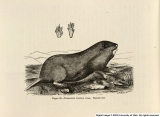
Show 224 EXPLORATION OF THE CANONS OF THE COLORADO. jaw, about half-way from nose to eye, just underneath the whisker-patch, and cur\7es loosely around the side of the head to the angle of the jaw. The general outline of the orifice is semicircular (or rather semipyriform, since the broadest part sags down a little) ; the inner border being the proper integument of the side of the head. The lining of the sac is ordinary integument, of rather more delicate texture ; it is clothed with fine fur. On the side next the head, the ordinary fur of the parts makes directly into the pouch; on the outside, the fine fur continues to the brim, where it is met by the ordinary external pelage. Between the two layers of skin rests a thin bed of muscular fibers (perhaps a modified platysma myoides), serving for such contractile movements as the receptacle may be susceptible of. But the connection between the folds of skin is so slight and loose that the pouch may, with little force, be turned completely inside out, though it does not appear that this ever occurs in life. A full-sized pouch will admit three fingers as far as the first joint. The small eyes are situated midway between the nose and ears, below the line between these two ; and, if anything, they are rather nearer the latter than the former. The ears have been described in varying terms, leaving a doubt whether there was an auricle or not; but it is proper to say that the auricle is obsolete. The large circular orifice of the meatus externus is surrounded by a raised brim, rather thicker, if not higher, behind than before, and, as such, constituting a rudimentary pinna; but there is nothing to be called a flap (which is something that may be turned over). The large, strong, and eminently fossorial fore feet recall those of the mole in some respects, though they occupy the usual position with reference to the axis of the limb-sole downward instead of tilted over. The hand itself is shorter than the hind foot; but the immense claws reverse the proportion of the two as a whole. The palm is broader than the sole, and perfectly naked. At the juncture with the wrist, it presents two great movable callous tubercles, which probably have a bearing upon the great force of flexion of the member; otherwise the palm is flat, devoid of special pads or callosities, and may be thrown into indeterminate rugae or sulci, according to the movements of the parts. There are five digits, whose relative lengths are nearly the same as those of the claws they respectively bear. All the claws, |