| OCR Text |
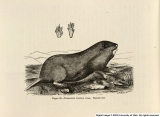
Show COUES ON GEOMYS AND THOMOMYS - G. TUZA. 231 dry and alcoholic).-This species, apparently distinct, nevertheless resembles G. bursarius so closely, that no general points of difference in size, sliape, or color can be adduced for their separation. There are, however, certain tangible characters, not necessarily the same as those given by authors, For instance, Audubon and Bachman dwell upon certain supposed differences in the structure of the pouch; but their observations rest upon bad taxidermy, and have no foundation in nature, the pouches in the two species being identical. These authors and some others speak of the upper incisors as single-grooved. This, if so, would be a strong feature: but it, unfortunately, is not the case; for, in all the numerous specimens I have examined, the upper incisors are double-grooved, as in G. bursarius, the fine second groove being perceptible as a delicate line of impression running along the inner margin of the tooth. It is perfectly distint, as a rule; and in no case have I failed to recognize clearly at least a trace of it, though in.some instances it is faint, and liable to be overlooked if not closely examined. Baird says that this groove is obsolete in old age, implying that such is the rule: but, while not doubting that such may occur, I must consider it as the exception; for, as just said, I have never yet failed to recognize at least a trace of it. G. tuza, therefore, has double-grooved incisors, like G. bursarias; the point of dental discrepancy lies elsewhere. In bursarius, the main groove bisects what is left of the face of the tooth, after subtracting the portion cut off by the inner groove; and this latter is always distinct. In G. tuza, the main groove divides what is left of the face of the tooth, after subtracting the portion cut off by the inner groove, into two unequal portions, whereof the exterior is the smaller; and the inner groove, always slight, may be faint, obscure, or perhaps sometimes obsolete. This is the whole case, as far as the incisors are concerned. The only other character of G. tuza I can appreciate is the nakedness of the tail and feet-especially the former. It is true that in G. bursarius the nakedness of these parts is sometimes noticeable; but it seems to be not carried, except perhaps in extreme cases, to the extent witnessed, as a rule, in G. tuza. The latter thus corresponds with G. hispidus in this respect, though very different in other features. In the best-marked cases, the tail is perfectly naked beyond the enlarged hairy base; the skin may be stuffed out to the caliber of a stout goose-quill, and has then a peculiar bladdery appear- |