| OCR Text |
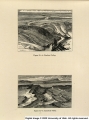
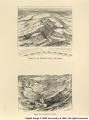
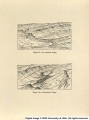
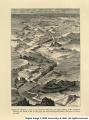
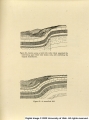
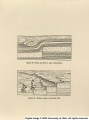
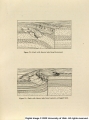
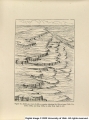
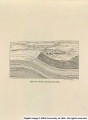
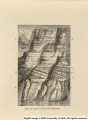
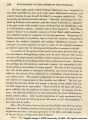
Show 184 EXPLORATION OF THE CANONS OF THE COLORADO. above and the horizontal beds below, unbroken; the flexure is complete, and we have a monodinal fold, as represented in Figure 67- Still another variation is found. In the same vertical section we may sometimes see that a bed composed of a somewhat brittle material is broken so as to form a fault, while the bed above or below, composed of a more flexible material, is bent so as to form a fold, and thus a fault and fold will be represented in the same cross section as in Figure 68. Thus it is seen that the transformation of a fold into a fault may-occur in two ways-longitudinally along the course of the fault, and vertically in the strata. The flexures, or monoclinal folds, also change in character, for the dip of the beds may vary greatly-from two or three to ninety degrees-and if we trace such a fold along its course, commencing at its transformation from a fault, we may find the flexure becoming less and less, until it can scarcely be detected, by the eye, and then, perhaps, increase gradually into an abrupt fold, and then into a fault, reproducing, in some irregular way, the varieties of faulting above described. These faults run in lines approximately parallel, and divide the district under consideration into long belts, or blocks, and one edge of each block usually lies at the foot of an escarpment, the other at the summit of an escarpment. In examining the down-throw of these blocks, it is observed that the edge which lies against the foot of an escarpment has usually been thrown down much more than the opposite one, so that the blocks are tilted more or less. The relative amount of the downfall of these two edges is ever'changeable. There are cases where the summit edge seems to have preserved its original position without down-throw, and there are other cases where the summit edge seems to have fallen quite as much as the other. There is yet another change rung on these displacements. In some places the beds, at the edge of the table, lying against the foot of the escarpment, are turned down, while farther back from the fault, toward the summit edge, the beds are approximately horizontal. This is represented in Figure 70. Thus the long, narrow blocks, into which the country is divided by these displacements, are warped, or twisted. These faults and folds, thus ever changing in their characteristics, produce like changeable features in the topography of the country. A sharp |