| OCR Text |
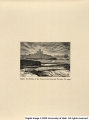
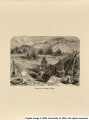
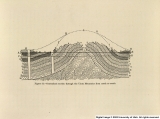
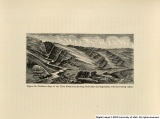
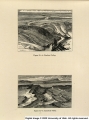
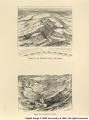
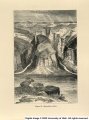
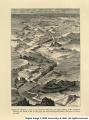
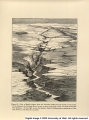
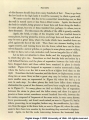
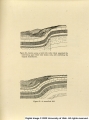
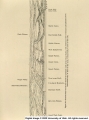
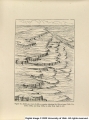
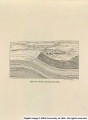
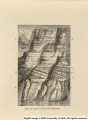
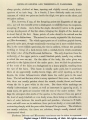
Show THE UINTA FOLD. 155 will be through sandstones and shales, unlike those seen in the first section; then you will strike the summit of the first section. Continuing down for 24,000 feet, the first will be reproduced, stratum for stratum. Now start on either side of the fold, and cross to its center, and you will pass over the same series of strata in the same order as you would in descending the first mentioned shaft, and in the second also, below the upper 8,000 feet. Now pass again from the center to the flank of the fold, in either direction, and you can study the same rocks in the same order as you would in ascending these shafts. It will thus be seen that in these truncated wrinkles we are enabled to study geological formations without descending into the depths of the earth. * Figure 51 has been constructed for the purpose of graphically expressing some of the important facts observed in the great Uinta Fold. In this, the beds are seen to turn up in a great flexure, and to be cut away above, the higher beds more than the lower; thus 4, 4-4, 4, has been cut away much more than 5, 5-5, 5; and 10,10-10,10 has suffered much less erosion than the beds above it. The only place where the water has carried it away is at Y, the bottom of the canon. In this diagram, the line A-B represents the lowest line of observation, as exhibited in the bed of the river. All below this line is theoretical. The line C-D represents the level of the sea. The stratum E, E-E, E was the last deposited antecedent to the commencement of the emergence of the summit of the fold. Had there been no erosion of the fold, the beds intervening between the broken line I, I, I, (which is a continuation of the lines E, E-E, E,) and the irregular line which represents the surface of the country, cutting the edges of the eroded beds, and passing through the lowest, No. 10, at Y, would still be found, but they have been carried away. The diagram does not properly represent the entire amount of erosion, from the fact that the vertical scale is exaggerated, and the beds have been extended beyond their proper limits, for the purpose of representing more clearly other facts of interest. It will be seen that in passing along the line A-B, (the bottom of the river channel,) from the shaft F, to the bottom of the canon Y, we are able to observe the beds 4, 5, 6, 7, 8, 9, 10, in the same order that we would in |