| OCR Text |
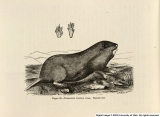
Show COUES ON GEOMYS AND THOMOMYS - G. CASTANOPS. 235 formly-colored family should exhibit "sharply-defined" or "symmetrically-subcircular" areas of color; and such proves not to be the case. The type of Pseudostoma castanops, now before me, in a good state of preservation, notwithstanding the vicissitudes of thirty years of museum existence, though bleached by long exposure to the light, still shows the curious chestnut head-patches, sharply defined against pale tawny-white surroundings, just as described at length by Professor Baird. But the animal was shedding its coat when killed; hence the appearance. The new fur is brightly colored, contrasting with the old faded and worn pelage.* One of the types of "cla/rkii" has the same color of the head, but this is also diffused with somewhat diminished intensity over the whole upper parts. Other specimens are entirely similar, with various shading of the main color. This may be described as a dull, pale chestnut, or almost fawn-color, more or less shaded with the plumbeous basal portions of the fur, which usually show more or less in this genus, be the fur never so smoothly laid. This tawny or fulvous tone of color is highly characteristic in comparison with the deeper and warmer chocolate or muddy browns which G. bursarius shows. On the under parts, though the plumbeous basal portion of the fur shows considerably, the general tint is whitish-quite white in comparison with the muddy gray of the same parts of G. bursarius. The whiskers are mostly colorless; they are fine and numerous, the longest about equaling the head. The claws are pale horn-color ; the naked palms and soles show various discoloration, perhaps according to the quality of the soil worked in. The incisors are orange, as usual. The few specimens of this species known to naturalists were procured in Texas and New Mexico. The animal would appear to be comparatively rare, as very few individuals, additional to those described by Professor Baird, have ever been collected, though we have plenty of the Thomomys (umbrinus\ of the same region. The written history of the species is brief and precise; determination of the identity of clarldi with castanops leaves nothing to be said on the score of synonymy. Castanops is to be retained as the prior name, and is unobjectionable, though it has proven not particularly pertinent * Various specimens of Geomys and Thomomys, changing pelage, show curious sharp wandering lines where the old and new fur fail to meet and fit exactly ; and such lines are often observed when the pelage appears to be all of an age. |