| OCR Text |
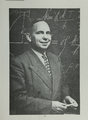
Show ll5 the problem was to use strain electrometry. By subjecting metal elect- rodes to strain (stretching them as with his work on fibers) and carefully measuring voltage potential, a picture of the kinetic process of corrosion was possible in terms of his absolute rate theory, varying the other parameters mentioned.68 In the early part of the l960's Eyring was involved in the writing of two books which dealt primarily with rate theory. The first, Modern Chemical Kinetics, was written principally for undergraduate chemistry students and other interested scientists as an introduction to the field of kinetics in chemistry. Eyring's son, E. M. Eyring, who by then was an established chemical kineticist, was co-author. The short one hundred, fourteen page paperback book was published by the Reinhold Publishing Corporation in l963 as part of an eighteen volume series of monographs on "Selected Topics in Modern Chemistry." The book sold exceptionally well, and it went through four printings. By l967, it was translated into Japanese and Spanish. absolute rate theory.69 It introduced thousands to the elements of The next year, Eyring's fifth book, Statistical Mechanics and Dynamics appeared. The book, co-authored by Douglas Henderson, Betsy Stover and Edward M. Eyring, was different from the usual treatment which bridges the gap between the quantum world or the molecule and the macroscopic world of matter which surround us. This book placed great emphasis on time and included the kinetic aspects of quantum mechanics. One reviewer said of this unique book: Eyring has set a much higher target: that of describing the main basic techniques and including all the applications one could hope to see mentioned in a single volume. It is indeed a luxury to have all this information so neatly assembled. Furthermore, the list of applications is impressive, ranging through specific heats, radiation, electric and magnetic properties, etc. to surface chemistry, |